Explainer: Why are women against data centers?
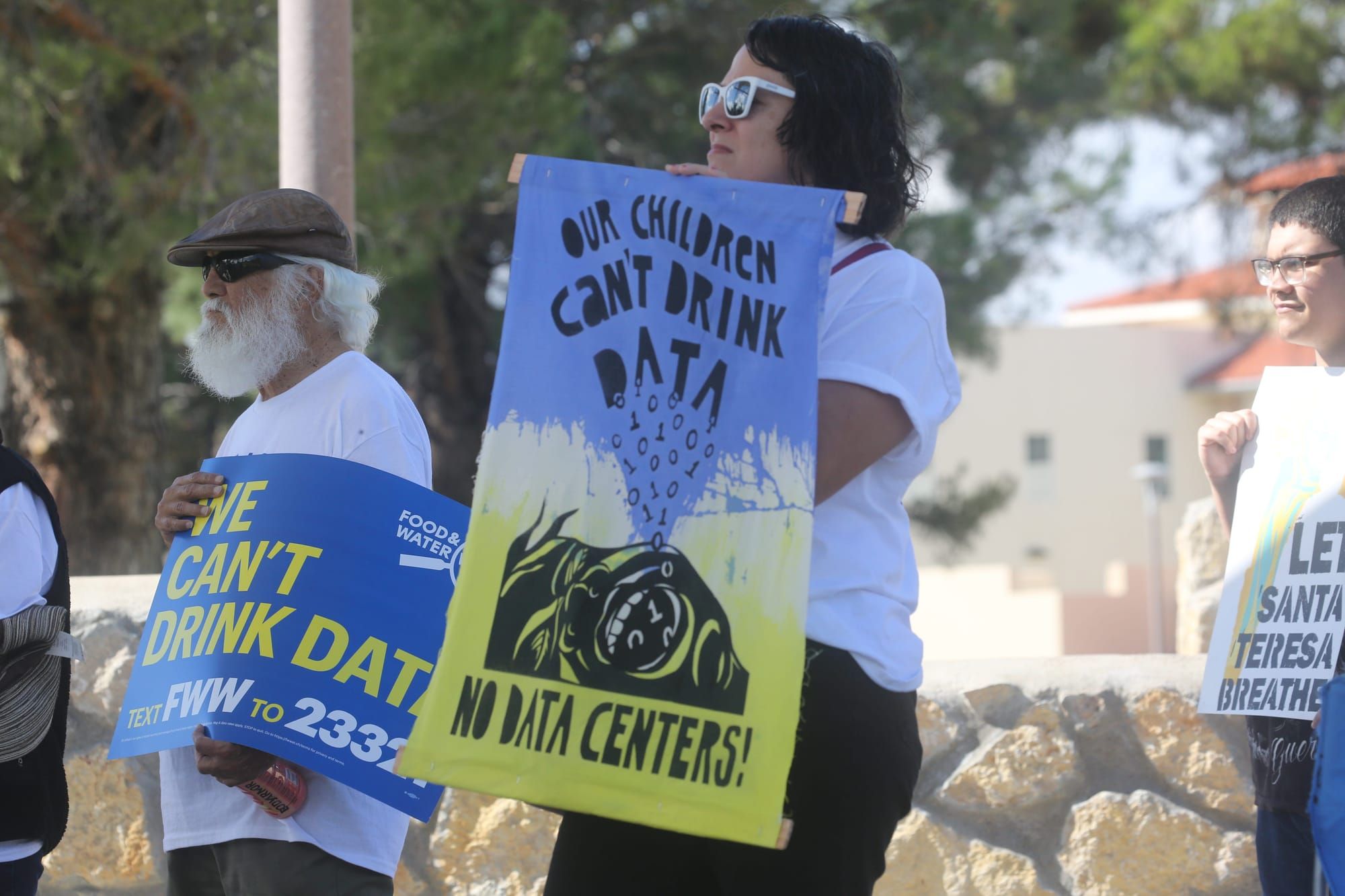
Research shows more women than men are worried about the environmental impact of Big Tech data centers on their lives and their communities. The highest cost of the centers, which use thousands of gallons of water each day, will likely be paid by women
What are data centers?
Data centers are buildings that hold IT equipment to run digital services and the mobile applications we use every day. These centers store, handle and distribute large amounts of data, making them crucial for developing artificial intelligence (AI) models, which typically need lots of information on which to train.
By 2030, data centers will consume 175% more power than they did in 2023 to meet the demands posed by AI development, according to Goldman Sachs Research. They’ll also need $6.7tn to “keep pace with the demand for compute power”, around 70% of which will come from AI.
Data centers are often owned and operated by big companies. For example, American AI developer Nvidia reported $96.2bn in revenue for the second quarter of this year; almost all – $89bn – of it came from data centers. Meanwhile, Amazon said it would spend around $220bn by the end of 2026 on more than 900 data centers across 50 countries.
The US has by far more data centers than any other country – more than 5,000, according to Data Center Map. The second highest is the UK, with 595. Despite civic resistance to these centers and community pushback, new data center construction is projected to ramp up worldwide. “We're seeing young and old, left and right, urban, rural, everybody in between getting involved in this movement to stop data centers here,” said Ben Inskeep, program director at environmental advocacy organization Citizens Action Coalition of Indiana, on the Fighting Fascism podcast this month.
What's the connection between data centers and water?
Data centers need a lot of water, mostly to keep the servers inside cool enough to run. It’s difficult to tell exactly how much water they use – projections vary and each center’s water footprint is unique according to its size. Daily estimates range from 300,000 gallons to 5m gallons, the latter of which is similar to what a small town uses. Recent projections aren’t looking good for future water consumption: by 2028, AI-related data centers in the US may use up to 32bn gallons of water annually – the same amount of water as 360,000 households per year.
To minimize their impact on local water supplies, some data center operators are exploring options like building data centers in the ocean (to use seawater instead) or using recycled water. But this isn’t the norm. Data centers need water that’s clean enough not to damage the equipment they rely on. Often, that supply comes from a community’s drinking water – meaning that data centers are sucking up water that would otherwise have gone to meeting people’s needs. The water grab is made worse by the fact that every fourth data center is located in an area that’s already experiencing water stress.
Even the wastewater coming out of data centers may negatively affect local communities: in September, Wyoming found that wastewater from one of Meta’s data centers contained hazardous bacteria. Meta said its own testing found no evidence of bacteria and questioned the findings.
Why do these centers matter to women?
According to a survey conducted by news site Politico earlier this year, 58% of American men said they supported building more data centers – compared with only 41% of women. One reason is that women are more worried about the environmental impacts of data centers than men; another is that they’re more skeptical of AI, concerned about being made redundant at work or finding themselves targeted by an abusive deepfake.
In addition, some research shows that women disproportionately shoulder the impacts from data centers in their communities. For example, data centers use a lot of energy, which contributes to higher electricity costs. This particularly affects women: they’re more likely to manage household finances and take on unpaid caregiving work, which means they’re the ones figuring out how to afford more expensive electricity in a household budget.
Moreover, data centers can create “heat islands” in local communities and raise the overall temperature by about 16F. Extreme heat is particularly dangerous to women, if they’re pregnant or on low incomes, as they are likely to skip medical treatment or health check-ups, making them more likely to experience “heat-related illness and long-term health effects”.

Are women leading the resistance?
While activists and advocates leading movements against data centers span all genders, several high-profile women have become faces of the resistance.
One of them is Erin Brockovich, best known for her role in taking Pacific Gas and Electric Company (PG&E) to court over contaminating the groundwater in Hinkley, California (and the movie starring Julia Roberts named after her). This year, she built an open-source map showing AI data centres in the US and opposition to them. “It’s happening in every US state, multiple counties, rural areas, ranches, farms and neighborhoods,” said Brockovich in an interview with the Guardian. “People watch nature because they respect it, they need it. And they’re watching it being destroyed.”
Krystal Two Bulls, executive director of Indigenous grassroots organization Honor the Earth, is leading its “Stop Data Colonialism” campaign; while Tania Rodríguez, co-founder of a movement in Chile called Mosacat, successfully campaigned against a planned Google data center; Aurora Gómez is leading Spain’s “Tu Nube Seca Mi Rio” movement (which translates to “Your Cloud Dries My River”).
“I’ve been organizing for 15 years, and it’s always been the case that women are leading our fights,” Danny Cendejas, a campaign specialist for MediaJustice, who works with grassroots movements across the country that are opposing data centers, told newsroom Daily Kos. “We are definitely seeing everyone join the fight, but we have to recognize the truth, and it’s women, trans, queer and nonbinary people leading the work.”
Why are we talking about this now?
Global resistance to data centers is picking up momentum amid an AI boom. Pause AI, a grassroots movement with presence in 17 countries, “saw a fourfold jump in sign-ups” for membership in August and September after news of AI potentially killing us all and agents gone rogue hit the headlines.
South Koreans are calling for tighter restrictions on data center development, and in Europe, public opposition has affected $42bn worth of data center investments due to delays in construction. Citizens in Chile, Mexico and Spain have been protesting data center construction for years.
In the US, the Trump administration has dismissed resistance to data centers as a “sick conspiracy”. Yet polling from earlier this year shows that 70% of Americans, across party lines, are against them. The public’s disapproval is so intense, analysts say it could affect the US midterm elections on 4 November, in which voters choose which party controls Congress – a decision that heavily affects how much control the Trump administration will have for its final two years.
“Some people don't like the tax breaks. Some people don't like the lack of transparency. Some people, especially that live right next to the projects, don't want to live next to a noisy, polluting, you know, box,” said Bryce Gustafson, program organizer at the Citizens Action Coalition of Indiana, on the Fighting Fascism podcast. “Folks from different ideologies are coming together and saying, ‘hey, this is my problem with it and we're going to come together and fight it.’”
[cr1]Edited by Liz Ford and Erica Hensley.
[cr2]Edited by Liz Ford and Erica Hensley.