Women in the United States are poorer by design
In the US, wealth reflects whose work is valued. That women are on the losing end of our economic system is no accident, writes sociologist Anna Malaika Tubbs
Nearly a decade ago, LaRonda Rasmussen wondered how much she was earning compared to the men she worked with. So, she asked her employers at The Walt Disney Company for an audit. What she didn’t expect was to uncover a pay gap issue that extended far beyond her individual paycheck.
Rasmussen ended up exposing a problem so endemic that it was costing women in the company millions of dollars. First, she discovered that six men with the same job title as hers were earning substantially more, including one man with several years less experience who, at the time, was making $20,000 a year more than she was.
In 2023, around 9,000 current and former female Disney employees joined Rasmussen’s class action lawsuit, alleging that women across “Disney-related companies” had been paid less than their male counterparts for doing similar work. In 2024, Disney agreed to a $43.25 million settlement and committed to ongoing pay-equity reviews and reforms – while continuing to deny wrongdoing.
We have heard the story before. A woman discovers a pay disparity, other women confirm it, and then an individual company is sued while maintaining that they didn’t do anything wrong.
As a sociologist, I spend much of my time thinking about the stories we inherit about how the world works. One of the most powerful stories Americans are taught is that money follows merit: if you work hard, contribute value and make good choices, you will be rewarded financially.
The American Dream depends on this premise and promise. It encourages us to see wealth as evidence of discipline, intelligence and effort, while viewing poverty as the result of poor decisions or personal failure. Most importantly, it tells us that money is neutral, that it simply reflects value wherever it finds it.
But money has never been neutral. In fact, money is the most powerful story human beings have ever created. Dollar bills and credit scores have value because we collectively agree that they do. Stock markets, banking systems, property rights and wages are all inventions. These inventions shape nearly every aspect of our lives. They determine where we live, what opportunities we have access to, whether we can leave unhealthy relationships, whether we can rest, whether we can dream and whether we can survive.
When something made-up becomes as powerful as money has, we have a responsibility to ask what values have been embedded inside it. Who benefits from the story it tells? Who pays the cost? And why have women found themselves on the losing end of an economic system that claims to reward value, while systematically undervaluing the labor most associated with them, both in and outside of companies? The answer matters because the growing disparities are difficult to ignore.
The motherhood penalty
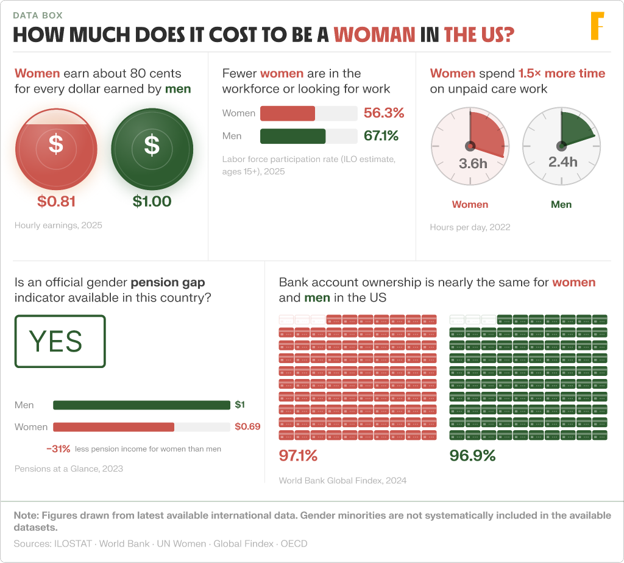
Globally, and in the US, women remain poorer than men, on average. Black, Indigenous, and Latina women make less than white women. Mothers experience significant earnings losses after having children, while fathers often experience earnings gains. Research published in 2023 found that in the US, full-time working fathers with children under the age of 18 earned 25% more than men with no children. Mothers, on the other hand, saw their salaries drop significantly when they had children, by around 40%, an outcome known as the ‘motherhood penalty.’
Women perform the majority of unpaid caregiving labor, while remaining economically penalized for doing so. These patterns persist across industries, generations and income levels. At some point, we have to stop treating cases like Rasmussen’s as individual outliers and more as unsurprising symptoms of the disease.
One of the clearest ways to understand what is happening is to first evaluate who our society chooses to reward. What kinds of work is considered valuable enough to deserve compensation? And what kinds of work are simply expected to be performed with no recognition or recompense?
For generations, women have been expected to perform the labor that makes every other form of labor possible. The labor of pregnancy. The labor of birth. The labor of feeding children. The labor of caring for elderly relatives. The labor of maintaining households. The labor of remembering birthdays, scheduling appointments, coordinating transportation, monitoring emotional wellbeing, resolving conflict and creating the conditions that allow families and communities to function. Without this labor, society would collapse.

Every worker, executive, entrepreneur, politician, athlete and billionaire depends on someone having cared for them first and that someone is most often a woman. Globally, women and girls spend 2.5 times more hours per day on unpaid care work than men. Yet much of this labor remains economically invisible. Not because it lacks value. But because the people historically associated with it have been assigned less value.
Many women find themselves doing work that is simultaneously treated as indispensable and invisible: the hours spent comforting a sick child. The planning required to keep a household running. The emotional labor involved in helping children navigate the world. The countless tasks that no one notices unless they are left undone. None of this appears on a paycheck. Yet without it, we cannot thrive. A 2020 study by Oxfam showed that across the world the economic value of women’s unpaid domestic and care work amounts to at least $10.8 trillion every year – more than the world’s top two most valuable companies, Nvidia and Alphabet, combined.
This contradiction reveals something important. Money does not simply measure value. Money determines what a society chooses to value. And the more you know about American history, the more you realize that this contradiction is not accidental.
It’s patriarchy, not oligarchy
I am often asked whether the fundamental problem facing the United States today is oligarchy. It is a fair question. Wealth inequality has reached staggering levels, and billionaires exert enormous political influence, shaping public policy, while economic insecurity defines every part of daily life for millions of people.
My answer often surprises people: Oligarchy is not the issue, patriarchy is. Capitalism and money are not separate from the larger system I call “American patriarchy”. They are its most effective tools.
In my book Erased, I define American patriarchy as the guiding structure of the United States: a hierarchy that assigns human value according to proximity to an ideal, historically rooted in wealthy white manhood. It is not simply sexism. It is a system that organizes race, gender, citizenship, sexuality, ability and class into categories of worth and belonging while convincing us that the resulting inequalities are natural. Money became one of the primary ways this hierarchy was maintained.
The founders of the United States are often remembered as revolutionaries and, in many ways, they were. They challenged one of the most powerful empires in the world and won. But after the Revolution, many of them became deeply concerned about what revolutionary thinking might mean if applied consistently: women were demanding greater participation; enslaved people were continuing to fight for freedom; Indigenous nations remained sovereign and resistant; poor people were rebelling against mistreatment.
The Constitution the founders produced excluded women from political participation, protected slavery, limited democratic access and concentrated authority among a relatively small group of people. What emerged was a social order organized around a gendered and racial hierarchy.
Money was made up to enforce that hierarchy. For much of American history, women’s economic dependence was written directly into law. Under coverture, married women could not independently own property, sign contracts, or control wages. A married woman’s economic existence was absorbed into that of her husband.
Dependence was not an unintended consequence. It was, and continues to be, the point. A woman who lacks financial autonomy has fewer options for leaving an abusive relationship, pursuing education, controlling her future, or challenging the social order itself.
Restricting access to money has always restricted access to freedom. The same logic appeared in even more brutal form under slavery. Black women who were enslaved generated wealth not only through their labor but through their reproductive capacities as well. Their children inherited enslaved status, meaning reproduction itself became monetized. Their bodies generated enormous economic value for others while they themselves were denied ownership, autonomy, and recognition.
How money underpins patriarchy
Even after many of these formal barriers have disappeared, the broader architecture remains intact. Women could not obtain credit cards independently until the 1970s. Banks openly discriminated against black families seeking mortgages. Redlining prevented generations of black Americans from building wealth through homeownership. Indigenous communities were systematically dispossessed. Immigration laws determined who could access economic opportunity and who could not. The effects of all of these issues persist to this day.
Again and again, money became a mechanism through which social value was assigned and reinforced, through which American patriarchy was upheld.
Yet one of the most effective aspects of the system is that it encourages us to view each example in isolation. Today, the gender pay gap has become a workplace issue. The motherhood penalty is a family issue and childcare is a personal issue. The black maternal health crisis is seen as a healthcare issue and financial abuse, and a relationship issue. Entrenched racial wealth gaps become a historical issue. Each symptom receives its own explanation.
The truth is that these issues are all connected. When women are expected to perform unpaid caregiving labor, they have less time for paid work. When caregiving is devalued, the professions associated with it are often underpaid. When women earn less, they accumulate less wealth. When they accumulate less wealth, they have less economic power and fewer choices. When they have fewer choices, they become more vulnerable to exploitation and control. The cycle reproduces itself.
 Eliza Anyangwe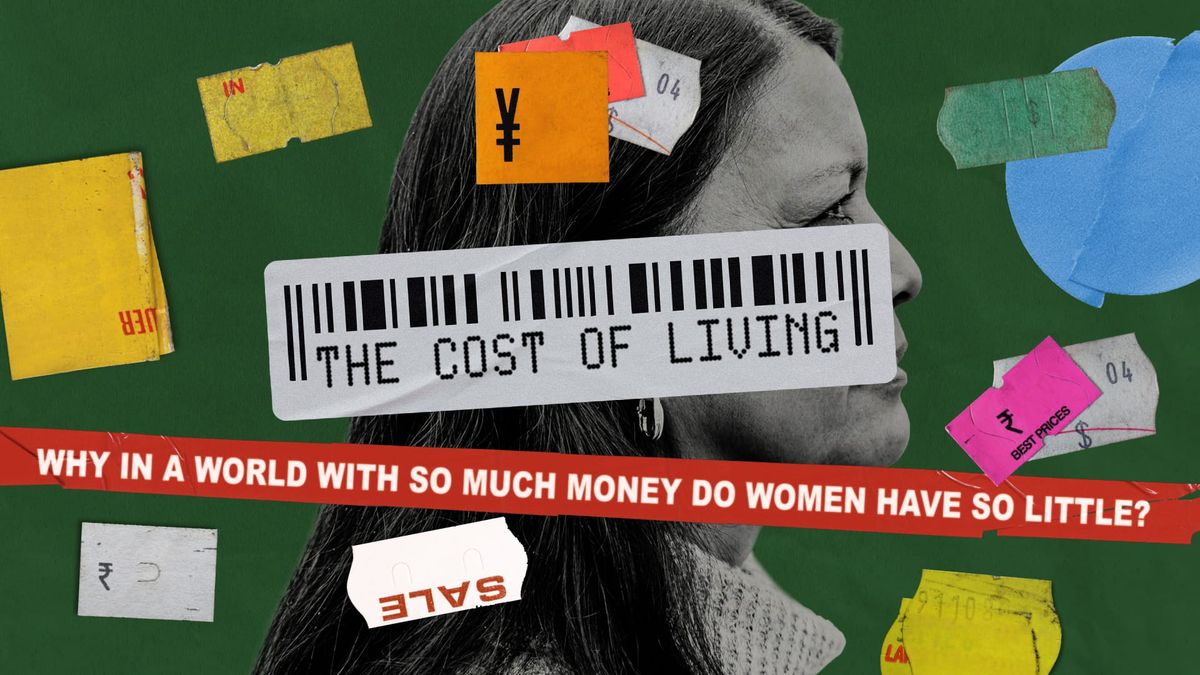
It’s a pattern many have spent years trying to explain away as misunderstandings, bad luck, unfortunate timing or isolated incidents of discrimination. When we recognize the pattern, we stop blaming ourselves. We stop believing that every struggle is a personal failure and we become better equipped to imagine alternatives. Women have been imagining those alternatives for a very long time.
Throughout American history, women have repeatedly built systems of support when existing institutions failed them. Black women established mutual aid societies that provided financial assistance, healthcare, childcare, and community support. Women organized cooperative networks, food-sharing programs, neighborhood caregiving systems, and grassroots movements that helped families survive.
Today, reproductive justice organizations continue that tradition by connecting economic security, bodily autonomy, healthcare access, childcare, and community support rather than treating them as separate issues. Mutual aid networks that expanded during the Covid-19 pandemic demonstrated once again that people, usually women, create systems rooted in recognizing value in all of us rather than just some of us.
These efforts matter not only because they provide immediate support but because they challenge the idea that any one group merits more than any other. They challenge the idea that caregiving is less valuable than profit generation. They challenge the idea that economic success should be measured solely through accumulation. And they remind us that another set of values is possible. And policy is what is necessary to protect these values.
Paid family leave, affordable childcare, pay transparency laws, living wages, accessible healthcare, protections against workplace discrimination, and stronger labor protections are all important steps toward building a society that uses money to facilitate our collective freedom, rather than suppress it.
Understanding the role money has played in maintaining inequalities in US society is not simply an academic exercise. Once we recognize that money is made up and that it has been used to assign value, not merely reflect it, we can begin to ask different questions.
What if women were rewarded equally based on their contributions? What if our economy rewarded care? What if the labor that sustains human life was valued as highly as the labor that generates profit?
This is why stories like LaRonda Rasmussen’s matter. Not because they reveal a single unfair employer. But because they expose a pattern that millions of women already recognize. Money’s power was established by a story a group of men told. Now is finally the time to tell a new one.
Lead illustration by Gabrielle Smith and data visualization by Carlotta Dotto. Edited by Anastasia Moloney and Eliza Anyangwe
Lead illustration by Gabrielle Smith and data visualization by Carlotta Dotto. Edited by Anastasia Moloney and Eliza Anyangwe