Investigation: With PayPal focused on profit, far-right groups go undetected and undeterred
PayPal prohibits any transactions "involving the promotion of hate or intolerance". Yet Fuller found at least nine far-right groups use its technology to sell merch or receive donations. Ex-staff say cuts and culture help explain why
"VIOLEURS ÉTRANGERS DEHORS" (FOREIGN RAPISTS OUT) reads the slogan printed in large block letters across a mug. This could be yours for €12 (US $14).
Or, for €29 (US $34), how about a baby-pink T-shirt emblazoned with the words “Antiwoke feminist”?
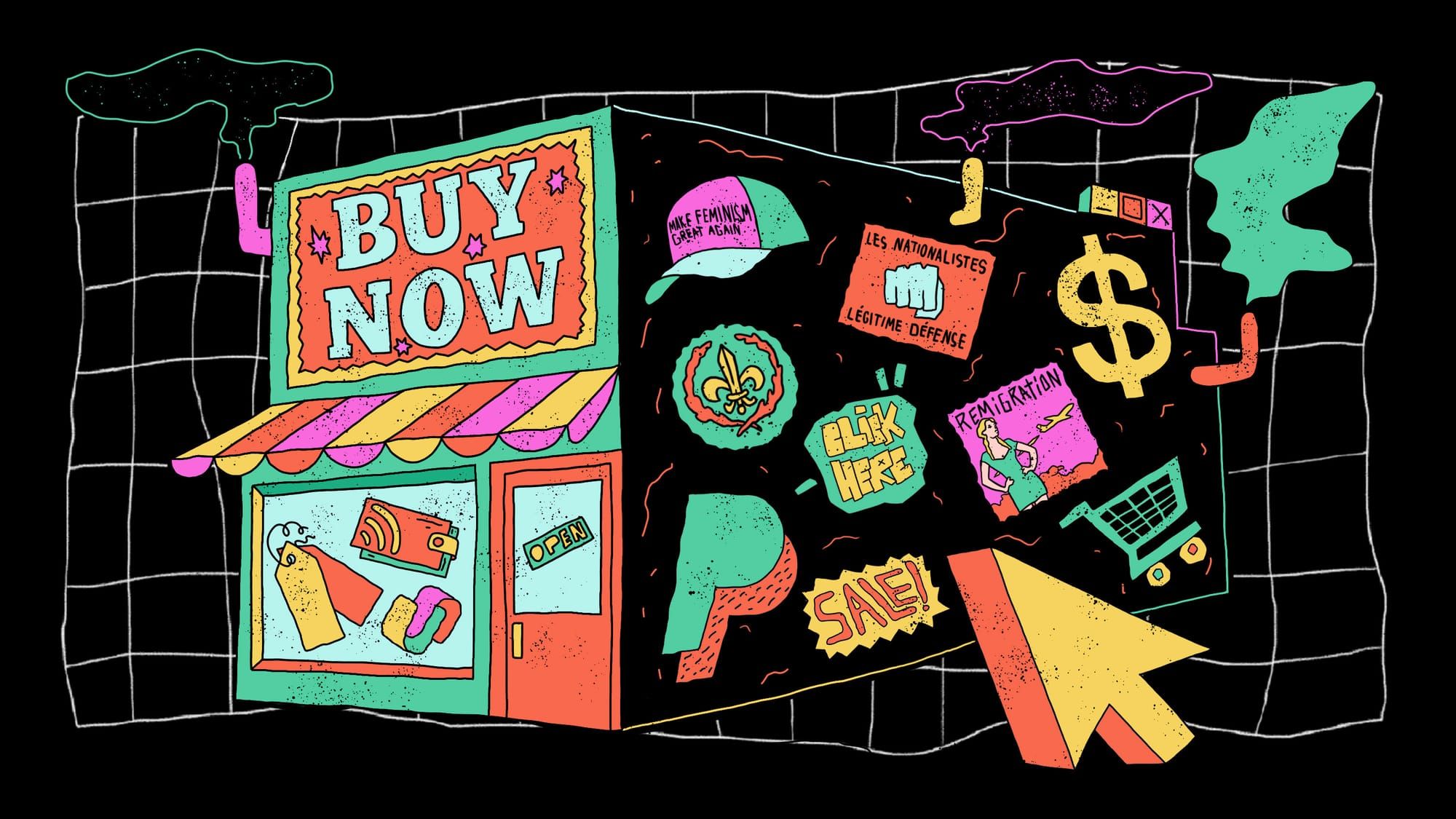
These products are sold online by Collectif Némésis, a French far-right women’s collective that has been linked to neo-Nazi groups but claims to campaign against gender-based violence. Sales of Némésis’ merchandise – which also features socks, posters and a “Make Feminism Great Again” cap – help to sanitize the group’s image and financially support its mission.
All transactions on the online shop can be processed via PayPal, despite the fact that many of the items are in clear breach of the platform’s own rules. And Némésis is not the only far-right group benefiting from PayPal's payment platforms.
Fuller found eight other sellers blending feminism, nationalism, xenophobic and Islamophobic rhetoric (collectively known as “femonationalists”) who use PayPal for payments.
What emerges from our investigation is evidence of a series of cracks that enable groups like Némésis to continue to process transactions through PayPal: the relatively small value of payments from such sellers, the limitations of the payment giant’s algorithms, its staffing choices, and a culture that ex-employees say prioritized revenue growth over enforcing its own acceptable use policy against extremists.

Three former PayPal employees – based in the United States and Europe – spoke to Fuller and accused the company of turning a blind eye.
“PayPal is very sales-driven,” said Robert, who asked that his name be changed to protect his identity. “Even on these smaller merchants, if they’re doing something bad, at the end of the day, PayPal is still earning a fee on those payments.”
PayPal reported $33.2 billion in net revenues last year, a 4% increase on 2024. In response to Fuller’s reporting that several far-right extremist groups use its technology, the company's director of corporate communications, Caitlin Girouard, said PayPal devotes “significant resources globally to fight and prevent illicit and illegal activity on our platform” and takes immediate action if an account is found to have violated its policies.
Girouard also said that PayPal partners with law enforcement globally to “investigate these matters” and evaluates each case “with a consistent and objective approach that is not driven by outside influence”. However, when Fuller asked for evidence to support her statements, Girouard did not provide any.
Fighting extremism or facilitating hate?
Fuller’s findings are at odds with PayPal’s public narrative and policies on tackling extremism.
In 2021, the company announced a partnership with Jewish advocacy group, the Anti-Defamation League, to “focus on further uncovering and disrupting the financial pipelines that support extremist and hate movements”. This alliance is understood to have ended in 2024 and the ADL did not reply to Fuller’s request for comment.
In 2022, when its acceptable use policy was last updated, PayPal informed users of what it considers "prohibited activities”. These include “transactions involving … the promotion of hate, violence, racial or other forms of intolerance that is discriminatory”.
However, in practice, PayPal does not always follow its own rules. The three ex-employees – whose roles included evaluating sellers for risk – all allege that a corporate culture that prioritized growth and profit motivated staff to find ways to approve extremist sellers rather than reject them. They said this often meant allowing such sellers to maintain accounts, but with restrictions.
Robert's job at PayPal involved analyzing whether merchants – from small ones to those earning millions of dollars per month – posed a financial or reputational risk to the company. He also trained other risk analysts and supervised their reviews.
According to Robert, a seller's extreme “political leanings” or conduct triggered internal discussions about whether or not PayPal should support their transactions. Yet those conversations were often about managing risk rather than removing a seller altogether, he said.
Robert’s team would try to work out ways to let PayPal keep such customers. As outlined in the company’s user agreement, that could involve limiting certain transactions or restricting sales to products that were not considered a reputational risk to the payments platform.
For example, Robert said PayPal might refuse to process ticket sales for an event while continuing to process donations linked to the same merchant.
Two other former PayPal employees – a senior due diligence investigator, who spent more than a decade at the company, and a senior risk analyst – also spoke to Fuller on the condition of anonymity, corroborating Robert’s account.
The investigator said he left PayPal because he was unhappy with what he described as a shift to a culture that valued getting things done quickly over getting them done right.
“I would argue that things have changed since I've left,” he said. “It’s not as ‘speak up and say something’ as it was when I was there.”
PayPal did not directly address the accounts of the three ex-employees when approached by Fuller for comment.
Extremists ‘slip through the cracks’
Fuller's investigation identified nine femonationalist groups or individuals, across Europe, who use PayPal to process merchandise sales or receive donations.
The term, coined by sociologist Sara Farris, describes nationalists who instrumentalize feminist themes to advance their xenophobic, racist or Islamophobic political agendas.
While the sellers use a range of payment methods, PayPal is the most widely available platform, appearing both directly on their websites and indirectly via third parties such as Etsy and Ko-fi.
Femonationalists are able to “slip through the cracks,” as business lawyer Mila Markova put it, by describing their activities in ways that evade PayPal’s detection systems.
“These systems have massive blind spots,” said Markova, who is based in Germany and specializes in helping clients challenge PayPal’s decisions to close accounts.
To become a seller on PayPal, users must be onboarded and submit information about the type of business they’re planning to run. According to the company’s website, there are 439 million active consumer and merchant accounts. To manage such volumes, PayPal relies on automated systems to handle onboarding.
However, Markova said that “extremists use coded language. And external web shops simply do not trigger the algorithm”.
PayPal also uses a machine learning system designed to detect fraud, but it’s not designed to identify extremism. According to the former employees Fuller spoke to, how those algorithms actually work is opaque.
“You’re trusting the PayPal system to catch those people,” Robert said, referring to extremists. “I’m not sure if I would trust the PayPal system.”
Back in 2015, PayPal reached a $7.7 million settlement with the US Treasury Department over potential sanctions violations, which included processing payments allegedly linked to weapons of mass destruction. The company said at the time that some of the transactions under investigation were not stopped because its automated filtering system was not working properly.
Even with the limitations of PayPal’s algorithms, detecting femonationalist activity is likely more difficult given the low value of their transactions. There is no public record of how much money Némésis and other far-right groups make through merchandise sales or donations.
According to Georgios Samaras, an assistant professor of public policy at King’s College London, these sums are probably small in both volume and value and therefore do not tend to trigger PayPal’s internal risk review systems.
Samaras – who researches policy responses to far-right extremism – said the merchandise identified by Fuller clearly “circulates exclusionary and racist content, including material tied to remigration [ethnic cleansing], deportation and hostility towards vulnerable groups”.
Yet, he pointed out that enforcing PayPal’s guidelines at this scale would generally be expensive and difficult. “How can you prove that a donation of £500 to one of those accounts actually is used to fund, let's just say, an attack on a migrant hotel?” Samaras added. “You can’t.”
Former employee, Robert, acknowledged that stricter enforcement of the guidelines would be “possible but come at the expense of not only revenue but also the average customer’s experience”.
“Making the requirements for onboarding more stringent would mean small businesses or hobbyists would struggle to sell via PayPal,” he explained.
Other experts said that PayPal’s offshoring of roles has compounded the problem, replacing experienced staff in Europe with cheaper hires abroad. Mariola Marzouk, an expert in trade-based money laundering, said such business decisions erode institutional knowledge – including the ability to spot subtle signs of far-right sellers – and are the main reason financial companies fail to catch criminal activity and extremism.
Accountable, if not responsible
Also active in Switzerland, Italy and Belgium, Némésis is facing growing scrutiny in France where, earlier in the year, a lawmaker urged the government to consider dissolving the group. For now, it continues to operate legally.
When approached for comment, Némésis denied any links to neo-Nazis and allegations of using feminism to promote a racist, Islamophobic and anti-immigrant agenda. In its emailed reply, the collective confirmed that it sells merchandise to fund its work and said that it didn’t “give a fuck” that this could be seen as a way of sanitizing its ideology.
Ultimately, the fact that Némésis and many other far-right groups are legal in their home countries makes regulating their use of global financial platforms difficult, according to experts.
“If they’re not listed entities under terrorism, if they're not banned from operating, then legally, they've broken no law,” said Natasha Tusikov, an associate professor of criminology at Toronto’s York University who's been researching payment platforms for a decade.
“It’s certainly awful that right-wing groups are raising money, but how much latitude do we want these companies to take with deciding who should be their customers?” she asked. “We can see it swinging the other way: they [PayPal] could say ‘no democratic, human rights, environmental groups’. And I think that would be incredibly dangerous.”
As PayPal’s new CEO, Enrique Lores, plans major staff cuts alongside a massive investment in AI systems, there is a risk that enforcement of the company’s acceptable use policy could be further deprioritized. If so, PayPal could make it easier for extremists – whether operating legally or not – to continue to use the platform.
Many of the experts and former PayPal employees interviewed by Fuller said the company can and should be doing more to address the issue.
“[PayPal] must be held responsible,” said Samaras of King’s College London. “I don’t think that the ideology spreads necessarily through a platform that allows transactions to take place. But it makes their survival an easier goal in the grand scheme of things.”
Lead illustration by Jawhar Soudani. Edited by Charlie Brinkhurst-Cuff and Eliza Anyangwe
Lead illustration by Jawhar Soudani. Edited by Charlie Brinkhurst-Cuff and Eliza Anyangwe