‘A chain around the ankle’: How Denmark's national digital ID fuels economic violence against women
Economic violence against women through the use of digital IDs is a growing, rarely recognized problem in Denmark and across Europe
Copenhagen, Denmark – It was after Mary gave birth to her first child that she noticed a stark shift in the behavior of her husband. As part of a prenuptial agreement the couple signed when they got married in Denmark in 2011, they had agreed to pool their finances.
But that never materialized. Instead, Mary remained reliant on pocket money her husband, the sole breadwinner, would transfer to her personal bank account while Mary pursued a Master’s degree.
When she would ask about the shared bank account they had planned to open, “every conversation turned into an argument,” said Mary, who declined to give her real name for fear of consequences in her ongoing legal case with her now ex-husband. He also began interrogating her about what she had bought and paid for. “I felt a bit like he was an investigator,” she said.
While her ex-husband earned up to 4 million kroner a year (about $610,000 in 2015), he would usually only give her 6,000 kroner ($915) per month, she said. This was meant to cover all expenses for her and their two children.
In practice, this became an unsettling form of control. Mary claimed he actively discouraged her from working and refused to help with childcare. As a result, she was totally reliant on her husband’s allowance. “It was very unstable because if he thought he'd already paid for petrol, for example, or if I didn't deserve the money, he could deduct it. So I could never quite count on what I'd get,” she said.
The control over her finances got worse. In early 2015, her bank advisor got in touch and mentioned, offhandedly, that she had logged into her online banking many times. She told him he was mistaken. “And suddenly, the penny dropped. I said – ‘It wasn't me. It's my husband who has logged in,’” she recalled.
Her husband had used NemID – Denmark's first version of its digital ID with a username, password and one-use codes on a physical card – to access her account around 21 times. The bank advisor offered to report it. Mary waved him off. “Looking back, I think I should have just had it reported... because it could have been used as evidence of a pattern today.”
Mary does not know how often her ex-husband abused her digital ID during their 11-year relationship to spy on her. But the pattern she refers to is economic violence: a form of domestic abuse in which a partner controls or coerces a victim through finances. From bank account monitoring to pocket money control and pressure to sign over shared assets under threat of divorce, these were moments that may have seemed disparate alone, but together, amounted to abuse.
“I often had this image in my head – that he was a cat, and I was a mouse,” she said.
Until recently, economic violence has been largely invisible – and is still often misunderstood or ignored. It is only in the past few years that researchers have begun to investigate how digital banking apps and national IDs can play a role in enabling it.
Denmark has no national data on how digital ID has an impact on economic abuse. But according to a 2026 report published by Danner, a non-profit that supports domestic violence survivors in Denmark, almost half of the women in its counseling program have experienced economic violence. Of those, 17% had their partner incur debt or apply for public funds in their name – often using digital ID as the instrument.
Digitized Denmark
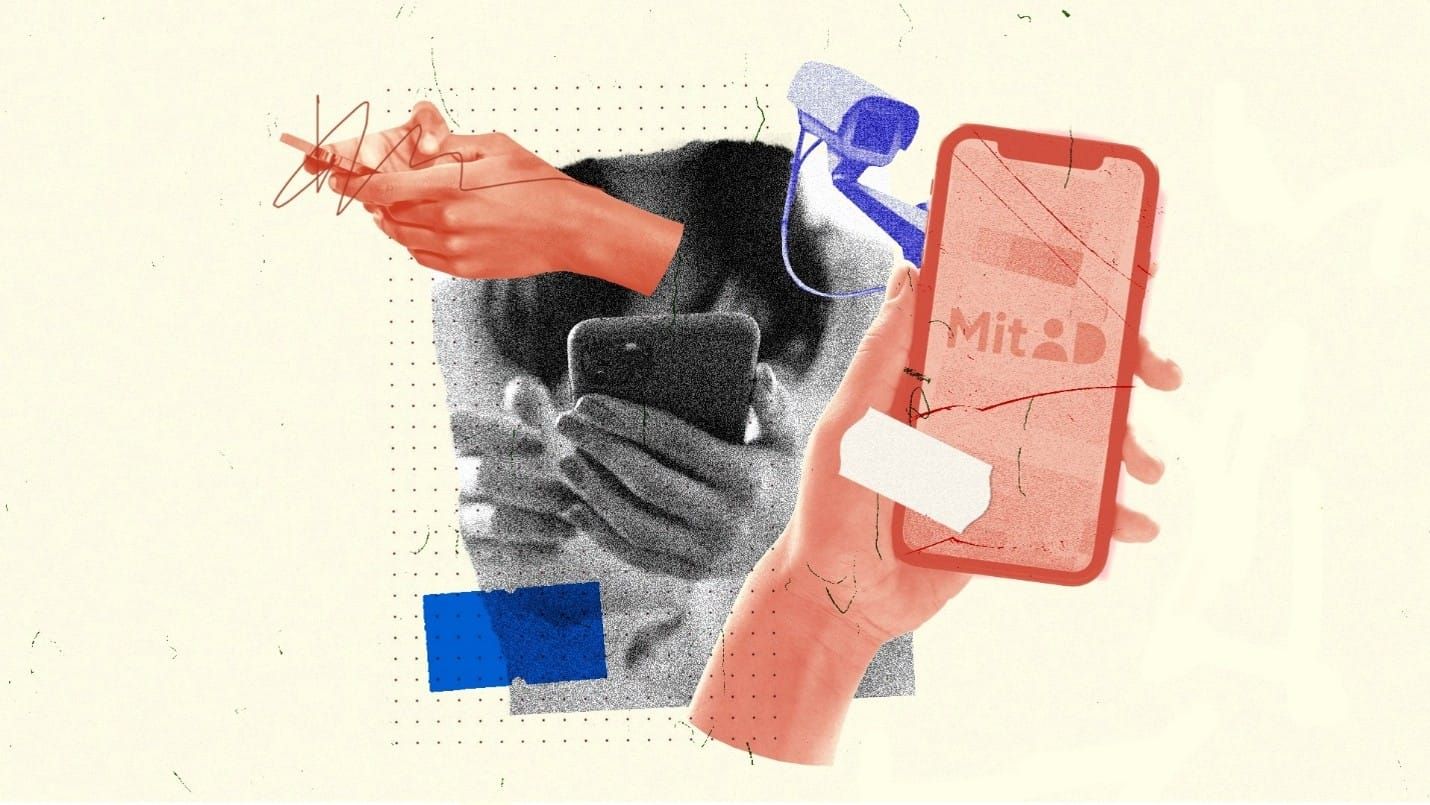
Denmark is one of the most digitized countries in Europe, and the country rolled out its first national digital identity system, NemID, in 2010. More than a decade later, in 2021, this was replaced with MitID: a smartphone-based digital master key to virtually every aspect of a resident’s life, from banking to medical prescription history.
Although not mandatory by law, it is very hard to live without it. Danish residents are required to use MitID to open bank accounts, pay their taxes and access most essential services.
MitID is more secure and differs from the previous ID in a key way as it relies on biometric authentication. Usually, users have to scan their face through the smartphone MitID app to log into their account. According to Malte Bundgaard Kolze, a criminologist and researcher at Copenhagen-based legal think tank Justitia, this makes MitID “very secure against all kinds of misuse” as someone can’t just “go into the system and use a code”, he said.
But there’s a blind spot. “Against strangers, it’s very effective. But against intimate partners, it’s not because they’re close to you,” Kolze said. An abusive partner can use “whatever means are at their disposal” to convince, coerce, or manipulate their victim into scanning their face to unlock the app, Kolze adds. “[MitID] is a good system, but it has this oversight that has a very negative impact on specifically this group,” said Kolze, referring to women in abusive relationships.
When victims try to prove economic abuse took place, MitID’s biometric authentication makes coercion extraordinarily difficult to establish and therefore get justice for. Maja Wallmeier Wolfgang, a criminologist who works as a consultant for the region of Nordjylland’s police department, said economic violence cases are particularly difficult to investigate because of “the whole consent part”, which makes proving abuse more challenging.
“If someone has logged in with MitID, it can be hard to know whether it's her who did it, or someone else who gained unauthorized access, or whether she was misled in certain ways,” she said.
Finance Denmark, an umbrella organization representing banks in the country that co-developed MitID with the Danish state agency for digital government, said it “feels deeply for the women who are subjected to economic violence.”
“That is why we also work together with Danner and LOKK [the national organization of women’s shelters] to help combat it,” said Kjeld Gosvig-Jensen, Finans Denmark's deputy director of law.
When asked what Finans Danmark can do to stop MitID from being weaponized to abuse women, Gosvig-Jensen said that “with respect to the actual use of MitID, Finans Danmark has no independent opportunity to react.”
The state agency for digital government declined Fuller's request for comment.
‘A chain around the ankle’
Across the European Union, one in five women experiences some form of economic violence, yet only nine European countries specifically criminalize it. Denmark is not one of them. However, the country criminalized psychological violence in 2019, including “taking control over a person's finances”.
This is “a very slim definition” of the abuse, according to Clara Kort Illeborg, a project consultant at LOKK.
Abusers, for example, can exploit the digital ID system to incur debt or apply for public funds in their partners’ names. “You can take out really big loans, change where welfare cheques go, move money around,” said Illeborg. “And do a lot of things with MitID without having to talk to a real human being.”
In Denmark, perpetrators can also abuse digital IDs to take out “quick loans” in a victim's name without their knowledge, according to Justitia. After all, it is easy: loans can be approved in minutes and payout can be directed to any bank account.
Denmark has a compensation scheme for victims of digital signature fraud. But researchers say that economic abuse victims are often left out by design. The scheme does not cover cases where an abuser takes out a loan in their victim’s name via digital ID and directs the funds to themselves versus the victim’s account first.
Danmarks Radio reported that a woman’s boyfriend had abused her NemID to take out a quick loan of 40,000 DKK ($6,200) in her name in 2017. Even though the man was subsequently convicted for fraud, the woman was taken to court by one of the banks involved, which wanted her to pay back the loan as well as any interest incurred.
It is one of the ways digital ID abuse can become a “chain around the ankle” that outlasts the relationship, according to Kolze. “Maybe you accrue a huge debt that you can never get rid of,” he said. “The problem with [economic violence] is that its consequences can be potentially life-spanning.”
In another case, a few years after leaving her abusive ex-partner, a woman named Tahmina received a letter from Denmark’s tax authority. She owed them almost half a million kroner ($78,120) for a company she had never even heard of. “I was shocked,” she told Danner. It turned out that her former partner had used her digital ID to open that company and rack up debt in her name.
Economic abuse rarely recognized
Experts say there is a limited understanding of economic violence within the frontline institution tasked with tackling it: the police. This year, Denmark earmarked 25 million kroner (almost $4 million) for police efforts to fight intimate partner violence. Yet this funding doesn’t always trickle down to economic violence being spotted.
“I've spoken to several women who reported their experiences to the police but felt that economic abuse was not recognized as a pattern,” said Danish economist and author Anne-Mette Barfod, who has written a book about economic violence. “As a result, many victims still feel that they are not taken seriously.”
In 2022, a report from the Nordic Journal of Criminal Science found that out of 357 police reports with case summaries about psychological violence in Denmark, economic violence was mentioned in only 35 of them.
Changing Danish law to specifically criminalize and clearly define economic violence could allow police officers to handle these cases better, said Wolfgang, the police consultant. “The police don't have a fully concrete definition of economic violence,” she said. Indeed, when Fuller called one of the police department’s press officers to request an interview, they asked, “What’s economic violence?”
‘Staggering rise’
Denmark is not an isolated case. Swedish police have said that economic abuse via digital ID is a problem in their country. In Norway, it's a well-known issue, too.
In the UK, where economic abuse is recognized as a crime, charity Surviving Economic Abuse estimates one in six women in the UK “has experienced economic abuse by a current or former partner in the 12 months”, and highlights the issue “rarely happens in isolation” and normally occurs alongside other forms of domestic abuse.
It is a problem that is on the rise in the UK, according to British charity Refuge, which reported a “staggering” 78% rise in referrals for cases of technology-facilitated abuse and economic abuse in the past year. In the Refuge report, one survivor spoke of emotional and economic abuse and said her partner had taken out a number of debts in her name, including for a luxury car worth over £100,000 ($135,900). The victim said: “I felt unable to refuse because of my partner’s coercive nature. It left me with a huge financial commitment that I didn’t want or feel able to say no to.”
This trend matters as by the end of this year, the EU plans to roll out Digital Identity Wallets (EDIW) across the bloc, set to work similarly to MitID. A recent research report warned that the Scandinavian examples of digital ID being abused by romantic partners are “a lesson European lawmakers need to take into account in the rollout of EDIW”.
Mary now lives in an apartment with her children. Since filing for divorce in 2022, she has come to realize how economic violence in her relationship played out not as one defining shock moment, but as the sum of different behaviors. Looking back on her experience, she believes that too often, society still understands economic violence as just something that involves money.
“But it's psychological. It completely undermines your foundation,” she said.
How we made it
Kilometres traveled: 10
Countries our sources are in: Denmark
Cold emails sent: 41
Hours of recordings: 85
Number of interviews: 6
Words written: 2070
Lead imagery by Gabrielle Smith. Edited by Anastasia Moloney and Charlie Brinkhurst-Cuff
Lead imagery by Gabrielle Smith. Edited by Anastasia Moloney and Charlie Brinkhurst-Cuff