In other worlds, women have wealth
The descendant of a multi-generational matrilineal household in South India, Megha Mohan knows that women’s poverty isn’t an inevitability. History has shown her the truth
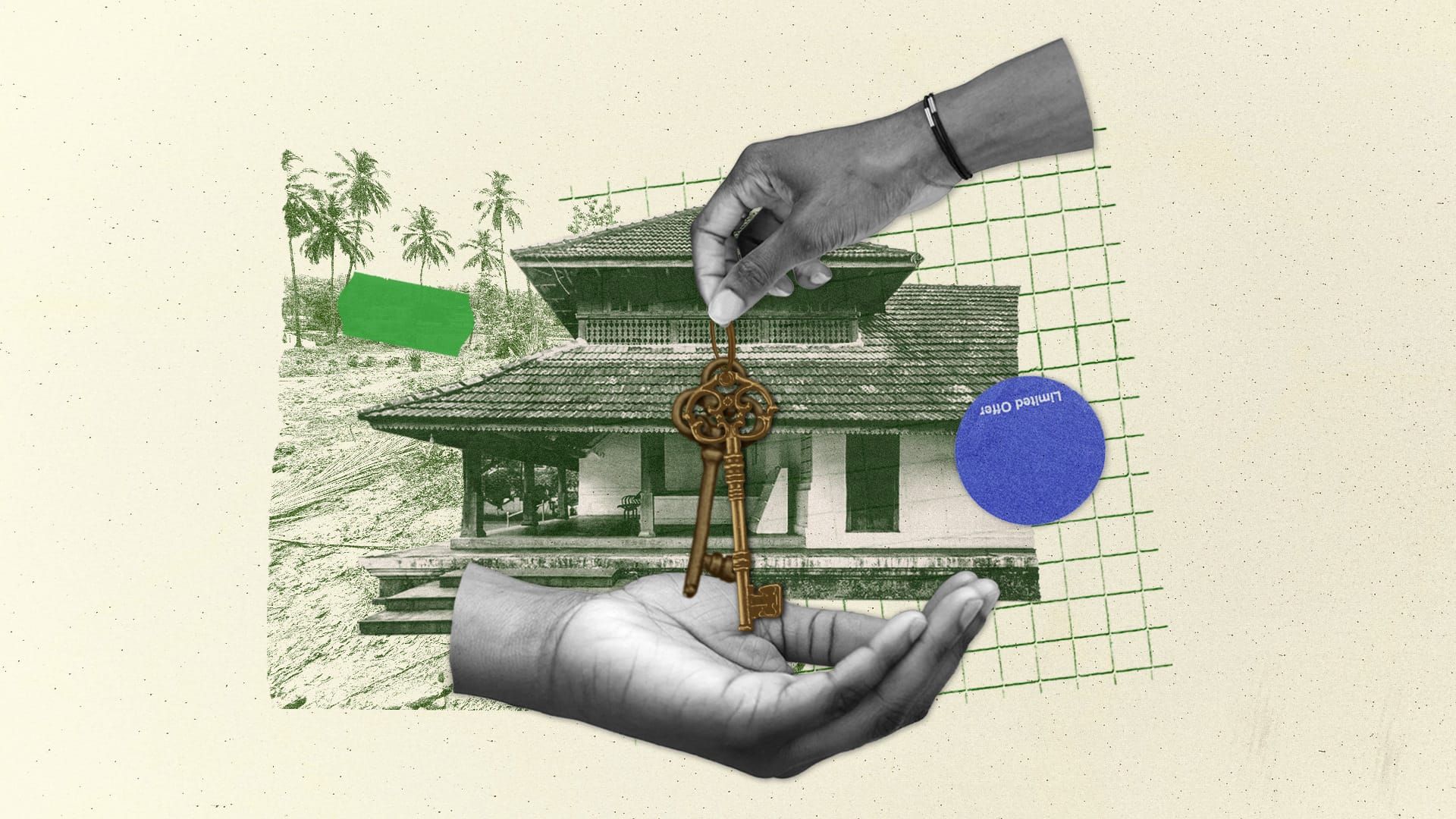
I am descended from women in South India who had wealth. My family’s multi-generational Nair caste matrilineal household was called Palayil Tharavad. A tharavad is, literally, a house built on a thara: a raised plinth of laterite and stone, lifted above the monsoon water.
But the word has never meant only the building itself. It means the family rooted there too: house and kin, land and lineage. And in my family, that ground was held by women. The boys were sent to serve the royal family and train as soldiers, so the tharavad became the domain of women.
For centuries, tharavads in our communities in South India were passed down through daughters, not sons. Under Marumakkathayam, which means “sister’s children”, descent ran through women; the house and land belonged to the female line. It’s an example of a parallel economy and society in which women have been accumulating and controlling wealth behind formal economic systems for centuries.

My great-grandmother’s tharavad was presided over by the eldest female relative, the Tharavad Amma. In my family, that woman was my great-grandmother’s mother, Palayil Kalyani. She took the name of her tharavad, not her husband. Kalyani translates as “beautiful”, but her authority was far more substantial than that. She negotiated the growth of her farms with local traders, and was consulted on every major decision affecting the family. A new romantic partner, the naming of a child, the direction of the household all required Palayil Kalyani’s blessing.
In my family’s memory, Palayil was a house where power moved from one female ancestor to the next. The eldest female relative held the keys, and they were a symbol of belonging, authority and continuity. A woman’s security did not depend entirely on marriage. Unmarried women, widows and daughters still had an established, recognized place to return to and a name that held them.
Matriliny ran the line – descent and inheritance passed through women, and children belonged to the mother's tharavad. This social system is proof that women’s wealth is not unnatural. It is not a modern fantasy. And in places like India, it has always existed.
And then, between 1925 and 1938, Kerala’s matrilineal inheritance system was taken apart by law and weakened under colonial rule – and finally erased from the statute book in 1975. British judges and administrators tried to fit female-line households into the patriarchal legal structures they understood.
The British rulers looked for a male head of the family, an owner, a manager, a man who could stand before the court and represent the household. This figure was often the oldest male member of the tharavad, the Karanavar. The colonists, helped by the local royal family in Kerala, undermined the tharavad women by liaising only with the elder men. The Karanavar swelled into an inflated role as property manager, and some autocratic Karanavars began to pull girls from education and oppress women at home. Society was never the same again.

There is hope for a different world, which can be found in parallel economies like the tharavad community system. What if some of the most sophisticated economic systems in the world today are the ones we barely recognize because they are happening in kitchens, WhatsApp groups, lending circles and communities of women quietly ensuring that nobody collapses alone?
One of the most compelling examples, to me, is the Somali practice known as ayuuto or hagbad: a rotating savings circle in which a group of women contributes a fixed amount at regular intervals, and one member receives the whole pot in turn. This is a practice that exists under many different names all over the world. In Ethiopia, the equb was devised by rural women who pooled butter between households long before they handled money. In Jamaica, these saving circles are known as a pardna. In Kenya, chama. In South Korea, there is the Kye; in India, “kitty parties”.
These systems are often spearheaded by women locked out of formal economies, and while they vary by country, class and purpose, the structure remains strikingly similar. On the surface, the structure is almost plain: a circle, a contribution, a turn, a pot. But that simplicity is the point. A bank asks for collateral, payslips, paperwork, a guarantor, a credit history, all proof that a woman already belongs to the formal economy. Saving circles ask different questions. Does our community know you? Are you trusted? What do you need the money for? It turns reputation into collateral, patience into credit, and community into financial infrastructure.
In camps for displaced people in Mogadishu, women have used ayuuto not as a charming tradition but as a survival mechanism. There one group of ten women gathered every month, each contributing $10 before handing the whole pot to one member. The money might pay for food, school fees, rent, stock for a tiny shop, or an emergency that could not wait for an NGO, a bank, or a government office to arrive.
In rural south China, anthropologists studying rotating savings circles found men were largely absent from them, and asked why. Spanning different centuries and currencies, the researchers found one recurring pattern: where the sums are small enough to be invisible to institutions, the members are women.
And in Europe there are other examples of parallel economies. From around 1200, in the towns of what are now Belgium and the Netherlands, women who wanted neither a husband nor a convent bought houses near one another to live in a community and provide mutual support. The residents were known as beguines.
Women kept what they owned and worked jobs – brewing, weaving, lace-making, nursing – and in most beguinages a portion of their earnings went into a common maintenance and support fund. Historians describe the walled enclosures as towns within towns, and the beguinages themselves as female guilds: independent corporations of women, answerable to no local authority.

While writing my book HERLANDS, I kept discovering other ways women had made wealth endure. These women-led parallel economic systems, practised and defended for centuries, were built around maintenance, reciprocity and collective resilience rather than extraction or accumulation. This means their successes can be hidden. There is no debt, no default and no eviction. These systems have been studied for decades – but as custom rather than as finance, which is why the knowledge has never reached the people who set the terms of credit.
These women-led communities were not innocent of the world around them. They were fragile, compromised, marked by caste, class, violence and hierarchy. And like in Kerala, some were dismantled by law. Others were reduced to historical memory: the name of a house, the story of a woman who held the keys, the sense that there had once been another way to belong.
But they are not relics. Where women are shut out of formal wealth, they build parallel versions of it, and have done so around the world, from Kerala to Mogadishu, without ever comparing notes. The same principles recur. Value is held whole rather than divided. Credit is extended based on what is known about a woman rather than on what can be seized from her. Wealth is tied to what cannot easily be liquidated – not gold, but a house, a lineage, a rotation, an obligation. The rules are made by the people living under them, which is why these systems can bend to a crisis faster than any bank or government.
To the banks and financial systems that have largely excluded women over the centuries, we should ask: Why does a property or land deed count as proof that a woman can be trusted with money, when decades of paying into a circle does not? Why is a woman's word worth less than her assets? And how have laws been created that mean a house held by a family for generations is ultimately a set of shares waiting to be divided?
In the case of my foremothers, their opinions were sought because their authority was understood. They were not only workers, wives or dependents. They were builders of houses, keepers of land, lenders of money, and creators of economic systems. Their legacy has been passed on to me. Today, I possess the key to the gate of Palayil: a heavy, rusted brass lock with two old keys.
The tragedy is not that women never had wealth. It is that so many of the worlds they built, and are still building, were dismantled, eroded, and rarely known and celebrated.
Co-published with Feminism in India and Lazy Women
HERLANDS: Lessons From Societies Where Women Make the Rules by Megha Mohan was published by Penguin Random House in March 2026.
Lead illustration by Gabrielle Smith and data visualization by Carlotta Dotto. Edited by Charlie Brinkhurst-Cuff and Anastasia Moloney
Lead illustration by Gabrielle Smith and data visualization by Carlotta Dotto. Edited by Charlie Brinkhurst-Cuff and Anastasia Moloney