Ai-jen Poo’s big idea: Make care work the engine of the AI era
The lifelong organizer discusses the invisible caregiving crisis in the US – and why building a new social contract around care is our best defense against automation and AI job displacement
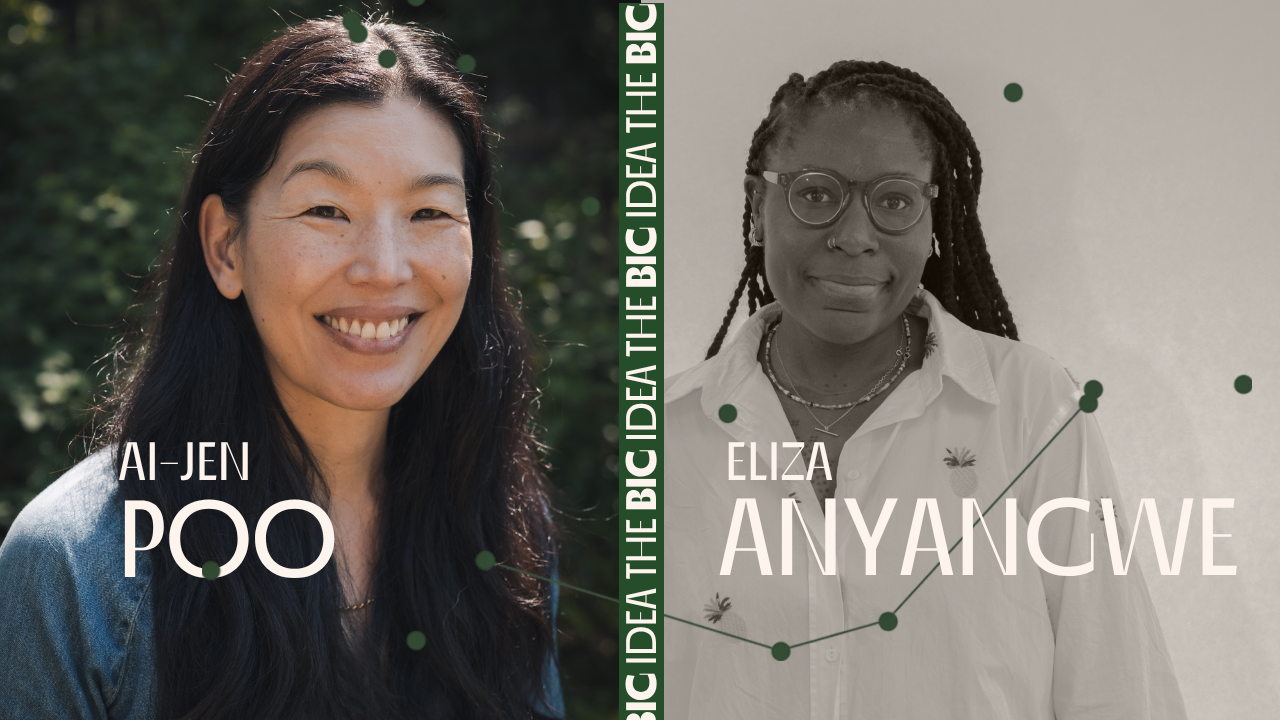
As 130 million Americans navigate the daily challenges of caregiving, lifelong labor organizer Ai-jen Poo talks with Fuller’s editor-in-chief, Eliza Anyangwe, about the urgent need for a unified care infrastructure.
The conversation covers the fragmentation of the US care system and the push for Universal Family Care; the vital, yet unprotected role of immigrant domestic workers; the power of storytelling through her production company's new film, Take Me Home; and why transforming care jobs into well-paid, unionized work could provide the ultimate social and economic safety net in an increasingly automated world.
Transcript
[00:00:00:02 - 00:00:02:11]
Eliza
Ai-jen Poo, welcome to The Big Idea. [00:00:02:11 - 00:00:03:18]
Ai-jen
Thank you.
Eliza
It is wonderful to be in conversation with you truly, truly.
Ai-jen
Likewise, I'm excited.
Eliza
I thought I would just start with, you know, why still this topic? Why still care? Anchor us in why this remains important, why this remains the work that you wake up to do every day.
[00:00:20:01 - 00:00:25:12]
Ai-jen
I am slightly obsessed. It's been 30 years and I'm still going. So, in the US, to begin with, it's the context that I know the best. There are 130 million of us who are navigating care every single day. And I would say that we do our very best to show up for our loved ones. But especially in the US, we've been told a story that this is a personal responsibility. And if we struggle to manage it, afford it, whatever the struggle may be, it's because we somehow failed. We don't have the right job, or we didn't save enough, or we didn't buy the right insurance, or whatever it may be. And how could it be that 130 million of us have failed, right? The masses in math it. No. I think there's a big breakdown here. Or maybe the fact that we've never ever built the appropriate systems, or infrastructure, or workforce, or policies to actually support this fundamental and universal human need that we share. And in modern life, most adults in a household have to work outside of the home all day in order to pay the bills. And so, who's going to care? And so this challenge just gets bigger and bigger as we live longer, and we need more care. Millennials having babies, and boomers aging into retirement, and wow. So I would say that as the years go by, it only becomes more urgent. And we haven't made the kind of progress that we need to make. And there are signals that it's possible. And I guess I'm just convinced that we are the generation that's going to change it all.
[00:02:20:07 - 00:02:35:12]
Eliza
What stands out to me from what you say, and from the introduction that you've given to us, is your commitment to hope. There have been, as you said, there are signals, and I would love for us to get into those signals. What is that hope rooted in?
[00:02:37:20 - 00:03:59:21]
Ai-jen
Well, I see it in caregivers all the time. I think it's true that there's a lot of loneliness and isolation among caregivers, but there's also, most of us become caregivers in a moment of crisis. And so this ability to tap into agency in the midst of chaos and crisis is something that I see in every caregiver that I meet. For generations, domestic workers have been excluded from basic rights and protections in our nation's labor laws, laws that most of us take for granted and rights that we assume we have, domestic workers don't have. And in the short time that I've been on this earth and doing this work, I've seen the first state in the country pass a domestic worker bill of rights because domestic workers in New York decided to fight for that. And since then, that was in 2010, it took seven years, but it happened. And then in 2010, it kind of set off a chain reaction where domestic workers and their supporters all over the country got inspired and launched campaigns. And this year, Washington state became the 13th state in the country to pass a domestic worker bill of rights this year, 2026,
Amidst all the chaos and helplessness and feeling of powerlessness. This historic bill was passed this year. Virginia this year became the first state in the South, the American South, to pass paid leave legislation. So, Virginia workers now have paid family and medical leave. So we are a society and also a species that is full of contradictions. And on the one hand, we can feel total helplessness and hopelessness. On the other hand, we can find our agency and move forward and make progress. And it is all happening right now.
[00:04:43:11 - 00:04:48:07]
Eliza
That is so well worth being reminded of. Thank you. You spoke a little bit to it. You've spent the last 30 years organizing around care. You are at the helm of two organizations. And today to something that said that change often takes about a 10 year arc. And so what we are living in now in terms even of the change that we are seeing, even the positive progress, is work that started about 10 years ago. When you think about care in the US, what was the work that was happening 10 years ago that made possible what you've just described? And what would you like to be laying the foundation stones for now so that in 10 years time, when we have this conversation again, we can point back to those building blocks.
[00:05:36:15 - 00:05:40:04]
Ai-jen
Ten years ago, we were modeling an idea that we call the universal family care. An idea that we would have, like Social Security, one fund, one social insurance program that we contribute to that we could all benefit from, that would help us pay for child care, for paid family and medical leave, and for aging and disability care or long term care. And so we were working with the National Academy of Social Insurance to convene the best researchers on these topics to model the viability of such a program, how much it would cost, whether it makes sense, how durable it would be, what it would require. And we had just released the data from that study, and it was also amidst a presidential election season. And there were advocates who were really pressing for child care and trying to get candidates a lower cost of child care agenda. And here we are 10 years later, and I just came from a week of meetings in Washington. And it is so profound because so many leaders in the House of Representatives were talking about the care agenda.
And they weren't just talking about child care. They were talking about the entirety of the agenda of how at every stage of life we need care. And we never know when that moment is going to occur, and we shouldn't have to be rich to be able to afford to care for our families in this country. And so all four of our agenda issues, so child care, paid leave, long-term care, and good jobs for care workers, very important.
I did actually reflect to say, wow, how far we have come, because 10 years ago, people literally looked at us like we had 10 heads, that we would dare to propose such a thing. And now everyone's talking about it in a slightly different format, not in one social insurance package, but in this idea that we need a holistic set of, we need a whole agenda, really, to support making caring for families in this country more sustainable and affordable for everyone.
[00:08:24:07 - 00:08:46:11]
Eliza
Okay, so let's talk about delivery. Does it look like making it more unified? A shared language, a shared vision, a shared proposal, is it fine, America is a federation, that there are different interpretations of this, which can also lead to different outcomes in different places, for better or for worse? What does it look like to deliver in a way that is most meaningful to caregivers?
[00:08:47:13 - 00:09:53:04]
Ai-jen
Well, the truth is, in the last 10 years, has been this fragmented approach where cities and these different issues, we make progress where we can on childcare, we make progress where we can on paid leave. That's been the last 10 years of planting seeds for what I think the next 10 years should be, which is national solutions and comprehensive approaches that reach not just people who are extremely poor, but everyone. There's a whole millions of families in the middle, people who earn just enough not to be eligible for a means-tested program, but not enough to afford the high cost of childcare or long-term care. We need a solution for those working and middle-class families in our country. So it needs to be universal. It needs to be accessible to all. And it needs to create good jobs, higher paying jobs in the care workforce. And it needs to also account for the fact that a third of our care workforce is immigrant. And until we have real meaningful pathways for immigrants to legalize their status and work in the care workforce, we're just going to be in a constant churn of a workforce crisis. There's no way we can care for each other in the United States of America without a strong immigrant workforce. So anyway, all this to say is the next 10 years are about realizing the promise of a social contract that supports American families of all walks of life to be able to afford to care for their loved ones.
[00:10:41:20 - 00:10:55:19]
Eliza
Where would you put narrative in the frame of the next 10 years? You co-founded a production company, I think it was this year that that launched. You have a film that is doing the festival tours at the moment, I think. And I thought this was very interesting and very, very astute because, as I often say, everything we are is story. And first, a story is told, and then that story is defended with economic, military, political power and intention. But then there's always an underpinning story. And when I hear you talk, for example, about immigration and the vital role that immigrants to the US have always played, but especially play in care. It seems to me that more than making the case for their economic contribution or taking on the fact that they might not be harmful or that we have them in our homes doing the most precious work. So shouldn't we normalize their legal status that perhaps sort of like zero to one is narrative, is story. How do you see story fitting in to the agenda around care, one that has been so neglected so long?
[00:11:57:02 - 00:13:33:11]
Ai-jen
It's so fundamental to what we're doing and what we have to do. It is very hard to value what you cannot see. And the experience of care and caregiving has been so invisible in our popular culture and literally hidden behind closed doors. And and yet it is such a universal experience. And so in order to, I think, make, create, design a future where care is truly supported and valued, we have to make it more visible and we have to make the fullness and dynamism and diversity of how care happens in our country visible so that we can actually support it well and build systems that are inclusive and imagine a future where it could all be supported differently. And this film, so one of the things that my organization, Caring Cross Generations, has been doing for about a decade is working with filmmakers, showrunners, screenwriters to tell care stories. And it's actually not a hard sell because caregiving stories are really interesting stories. I mean, it's got all the ingredients of great storytelling, which is like tension and drama and absurdity and surprise and all the things, heroes, anti-heroes, everything.
And so it's actually been a joy to find so many artists who want to tell these stories and support them, accompany them. And what it led us to is actually realizing that we could have a deeper kind of partnership to make sure that a whole there's all of these stories that are so compelling and there's such a vast audience for that don't get made because they just don't have the extra push in this chaotic media environment that they need. And so our production company is really about that. It's about connecting creators to the audiences that are yearning for their stories, which are the 130 million of us who are caregiving right now. We want to see and laugh at our own experiences. Right. And see them reflected back. And this new film, Take Me Home, that premiered at Sundance and just also screened at Tribeca and is making its way through the festival circuit. We're going to be in theaters in the fall starting in September. So we really hope everyone will go see this film, Take Me Home. The lead star actor is magnetic and irresistible Anna Sargent. She has a cognitive disability and it's really about her navigating care for her parents who are aging and all of them needing care and navigating it together. And it's based on the filmmakers family story. It's beautiful and it's hopeful and it ends. I don't want to do any spoilers here.
[00:15:22:02 - 00:15:22:23]
Eliza
Don't give it away.
[00:15:22:23 - 00:15:25:05]
Ai-jen
It is a hopeful end.
[00:15:27:06 - 00:15:58:10]
Eliza
That's beautiful. We will keep our eyes out for that. I wondered also to what extent you were talking before about universal family care, which struck me as a really ambitious idea. I wondered if you can speak a little bit to that because for a moment, if I follow your sort of timeline, your public timeline, there is a universal family care is everywhere for a period of time. I don't know if you can hear or see so much about it anymore. I was like, has it gone to ground? Has it morphed? Is there a Trojan horse happening here? What's going on?
[00:15:58:10 - 00:16:01:17]
Ai-jen
Oh, you really are an investigative journalist, aren't you? Great work. Amazing.
So there has been an evolution and I think that the art and the science of organizing at this scale is really to kind of figure out how you ride the wave to continue to go forward. And so we model the idea of universal family care and we actually then try to build the coalition that would be required to achieve it. What we found is that the people who work on child care and the people who work on paid leave and the people who work on long-term care and the people who care about the workforce are all working in different silos. And within those silos, there are debates about how to solve this particular problem and no one had really brought all of the silos together. So we spent five years basically trying to bring everyone together. And I think what we got everyone to agree to fairly quickly was the story. The story being that we are all part of intergenerational families and communities and these programs are not interchangeable. We need all of them and we'll need them at different times. And so we should figure out how we work together. But we couldn't agree on one social insurance plan or one approach. And so I kind of said, let's just power the story that we need a whole new approach to care in our country and it should support us at every stage of life. And we shouldn't be put it against each other. And these are not trade-offs that families can make or should have to make.
And so let's not make them against each other. And so we came together to say, how do we power this narrative, this new story of care and what we need together? And kind of stepped away from being attached to the policy. And then the pandemic hit. And it was an extraordinary moment because it was a moment of crisis. We had already been working together and we realized that we were on the verge of a total economic meltdown. And we were also in the midst of a care crisis where the pandemic had brought the crisis to everyone's doorstep. Literally everyone zooms green. People had children crawling all over them and they're trying to work on Zoom. And so that gave us a whole new context to think about how the agenda fits together. And we decided to launch an idea, which was to position care investments as infrastructure investments, understanding that in a time of economic crisis, the first thing you do is infrastructure because the jobs in infrastructure are an easy investment and they're high paying jobs. They circulate money in the economy and the work is actually building the long term foundation of what we need for economic and social thriving anyway.
And care is very similar. You know, supporting care jobs and making investments in care is not just an investment in circulating capital in the economy, but also in the long term health and wellbeing and resilience of the entire workforce. Right. Senator Casey at the time said it best. People need a bridge or a tunnel to get to work and others of us need child care. And so we then started championing the care agenda as an infrastructure investment during the pandemic. And we were successful in winning tens of billions of dollars in funding for care, for child care, for paid leave and for home care in the American Rescue Plan. And then moved towards getting all of those investments in the Build Back Better agenda and came one US Senator short of succeeding in a massive historic investment in care. And I would say that we did succeed in making positioning care as an economic issue for the first time, not a special interest, not a women's issue, but actually truly an economic issue. And we're still building on that progress.
[00:21:14:09 - 00:22:21:07]
Eliza
I wanted to ask about Build Back Better plans. We are currently at Fuller in our Cost of Living edition. So we take on a theme over a period of time and really look at it from three different beats that we cover. So labor, health, technology, climate, disinformation, but also from different geographic contexts. And we're currently looking at cost of living, which is essentially a broad beat to look at why do women still earn less than men? Why do they have social inclusion or social exclusion of women?
And of course, the value of women's work and what even should be labeled women's work. And one of the things we have been talking about is the reason for this edition now even predates, of course, rising energy prices or rising household costs. It goes back in part to the Build Back Better plan, the pandemic that forced us all to see that women bore the brunt of the shocks and were the least protected from them. And there was this moment that I don't know if you felt the same way. It felt so hopeful in that finally, right? Even the most dubious of Western leader was going, oh, we need to do something about our gender in equal worlds and our economies that invisibleize women's labor. And I feel now we've moved into a time of rising military spending. It just feels so much harder to make that case. But do you think the framing of infrastructure can still galvanize and mobilize resources in a post-COVID, post-Build Back Better world?
[00:23:12:08 - 00:23:14:06]
Ai-jen
I think that it will work with some audiences, but I don't think it's sufficient. And I think in the age of AI, that what we have going for us may be the most important thing of all, which is that care really gets to the heart of what is uniquely human and irreplaceable. And if nothing else, this extreme drive towards automation is going to force us to reflect upon what we truly need from each other as human beings. And I think it comes down to care. And care is the penultimate example of something that cannot be replaced that we don't want to be replaced, even if it could be. And so I think care is a way for us to pivot what it feels like a kind of runaway train. To get a hold of it and to talk about what we as human beings need from each other and what is required for us to live well in the future. And therefore what we should demand in terms of accountability and support and infrastructure. But I do and I fully believe that I've been making this comparison and I'm writing an article about it right now. It's also going in a book that I'm writing.
But in the 1930s, manufacturing jobs were dangerous sweatshop jobs that a lot of immigrants held and poverty wage jobs. And a combination of union organizing, like great union organizing, brave, courageous organizing on the part of thousands, hundreds of thousands of workers. And very bold federal policymaking that was really about a social contract. Really a promise that government, federal government was making to the people of this country for generations. Like a generational promise.
The combination of those two things allowed for manufacturing to be the biggest on-ramp to the middle class in the history of the world. It literally created an era of shared prosperity. Not everyone was included in that era, but there is no question that it did create this generational, this American dream, this pathway to the American dream. Now today, what we have is a care sector and a workforce that is the fastest-growing sector of workers because of the huge demand. And these are jobs that can't be outsourced. They won't be automated and we're going to need more of them in the future.
So I believe that we could imagine through a not-so-different formula of great organizing and very bold public policy that is about a social contract, a promise for the next few generations that we are making to the people of this country, that we could transform the care sector into the manufacturing of the AI era, into the greatest on-ramp to shared prosperity for the next era.
[00:27:14:16 - 00:27:21:07]
Ai-jen
So it's like people see the age of AI as this potentially doom-and-gloom scenario for workers and the threat of mass displacement of workers is very real. And within that, I see that that's actually a choice and that we could choose differently. And we have to do it quickly. We could choose actually a new era of shared prosperity and we frankly must.
[00:27:45:22 - 00:28:08:02]
Eliza
Okay, so help me give us some numbers to ground this as our conversation comes to a close. How many, what are the estimates of the number of care workers that you think just the US will need to meet the needs at either end of our lifespan? So what is that number?
[00:28:08:02 - 00:28:24:11]
Ai-jen
We currently have about 9 million workers across child care, early education and direct care. And on home care alone, we are anticipated to need at least 1.7 million more in the next decade. So 2036. The numbers of people over the age of 85 will double by the year 2040. We are, especially on the aging side of the generational spectrum, we are in need of exponentially more care and we already can't sustain the workforce that we have. So if we invested in making these jobs that people aspired to and wanted to stay in, these could be really great jobs that people could raise a family on and one generation it's easy to do that because you could actually begin with government investment in Medicaid for home care and in publicly funded child care and start to make that happen. Like it's not that we wouldn't have to invent anything new.
[00:29:34:13 - 00:30:25:21]
Eliza
I've been worried, I guess, because when I hear you talking about the possibility of, well, maybe not an AI boon for care workers, but an opportunity and one that I fully agree with you, we can't be complacent and just really accept the sort of AI future we're being told is coming or already upon us. So you're saying that we have a choice is really important. But what we are living through today is that the levels of automation we already have seem to be displacing predominantly, at least in the first instance, women workers. And I, you know, maybe it was a dark thought, but my little journalist heart that sees the worst in everything thought, aren't women going to lose jobs elsewhere? And then, you know, become what the Israeli writer, Yuval Noah Harari, has called before the useless class, right? They're not able to enter into the working class to then, you know, enter into greater prosperity. So I was like, is the useless class going to be largely women? And then are we going to have this large care need and just and then expect those women almost like on a conveyor belt to go and work in those areas without the requisite investment?
[00:30:58:17 - 00:31:20:23]
Eliza
So we will be meeting our care need while simultaneously displacing workers from other sectors. And like, what are the kind of breaks that we need to make sure that that is not the course that we're on? And if I'm hearing you right, what? Well, let me not answer your question myself. What do you think those breaks should be? Because it really seems like that might be the trajectory that we're on.
[00:31:22:07 - 00:31:34:21]
Ai-jen
We have to we have to raise the wages and create good jobs for this workforce. We have to unionize the workforce so that there can be actual negotiating power and institutions that can capture the power of workers politically to demand accountability on an ongoing basis. The unionization of the workforce in manufacturing was absolutely an essential part of the formula to getting to good jobs.
And so we have to have real density and real organizing and not just of care workers, but of all kinds of workers, including workers, women workers in sectors that are going to face a lot of displacement. And I think that the social contract isn't just about care that we need to usher in. We need we should have jobs guarantees. There should be a cost to displacement of workers. There should be, I mean, there's there should be a whole set of promises that we make care related and not care related to the working people of this country that we are not going to let you fall in and be a cog in a conveyor belt wheel for AI profits. It's not. And here's what I'll say is that by not engaging and looking for the hooks and the things that we can and should be demanding. Power is getting consolidated and people are losing their jobs. And those two dynamics actually are not inevitable. It is not inevitable that our entire future is in the hands of five tech CEOs. And we have to engage in order for that to not be. So it's not so it's it's only not inevitable if we engage. And I think engaging enough to be clear, like, here's what we need. We need a jobs guarantee. We need universal care so that if we lose our job and need to get retrained or want to try to start a business or want to pursue a creative pursuit that our families will be cared for, that we'll be able to. There will be a rent freeze so that we won't have to worry about losing becoming homeless. Right. Like there's a whole bunch of things. It's promises that we need to ask and demand, actually, get realized in this era so that we can be resilient.
[00:34:22:00 - 00:34:25:00]
Eliza
Absolutely. Thank you again for your time today.
[00:34:25:00 - 00:34:28:04]
Ai-jen
Thanks for having me. It's been fun talking.
Interviewer: Eliza Anyangwe
Guest: Ai-jen Poo
Producers: Imriel Morgan and David Roberts
Video editor: David Roberts