In France, a neo-Nazi ‘bodyguard’ was killed. These are the far-right ‘feminists’ he was supposed to be protecting
After a clash in Lyon led to the death of Quentin Deranque, a fringe identitarian group called Collectif Némésis has seized the moment – backed by powerful allies and blurring the line between feminism and the far right
The Institute for Political Studies in Lyon stands in a sombre square beneath a lofty, fluttering tricolour flag. The university shares its premises with The Resistance and Deportation History Centre, a site once used by the Gestapo as its headquarters, where thousands of Jews and resistance fighters were tortured and deported to Nazi concentration camps during the Second World War.
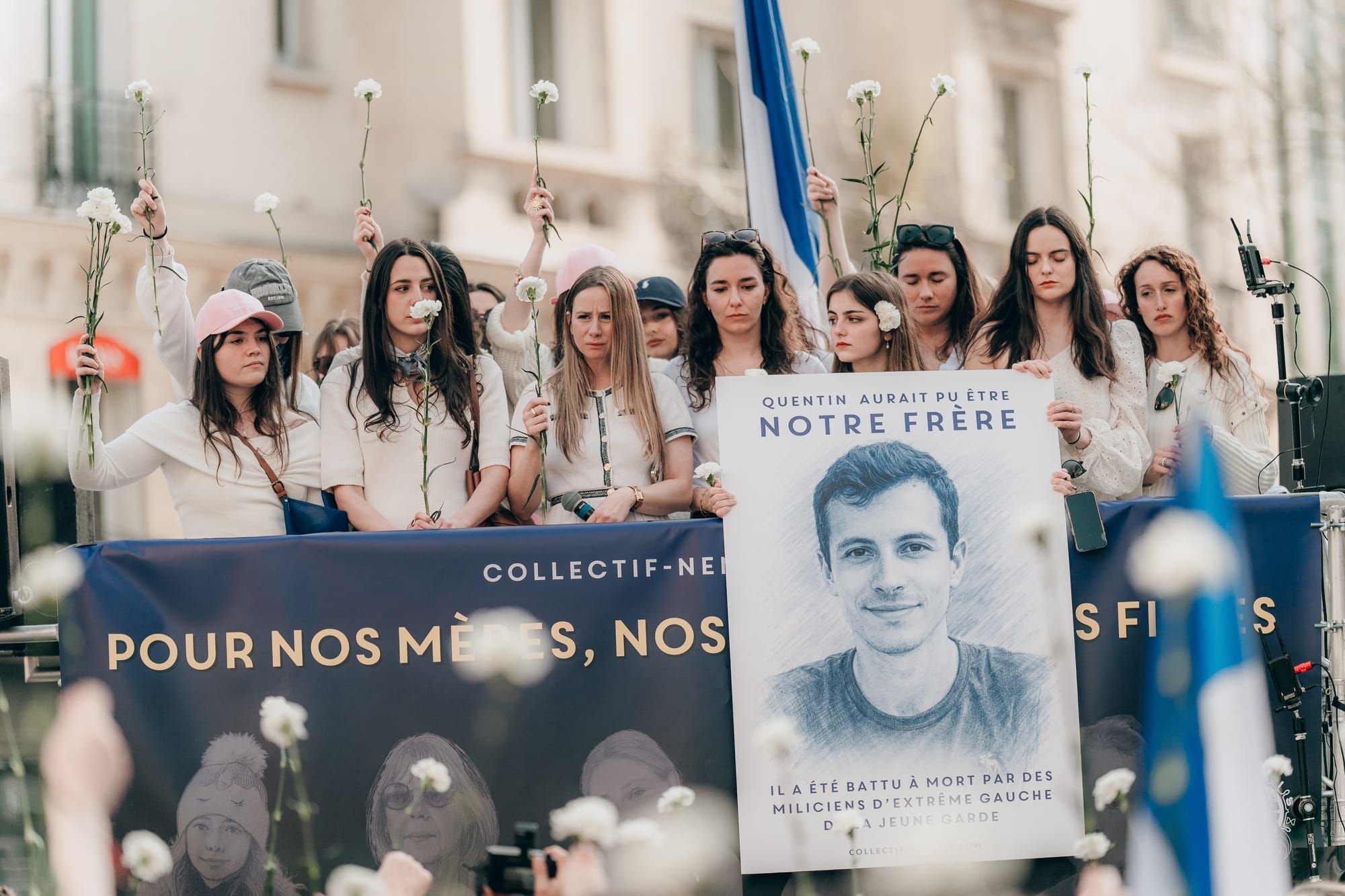
On 12 February 2026, the streets surrounding this same site became the scene of a series of street brawls between far-right and anti-fascist militants that would end in the death of Quentin Deranque, a young neo-Nazi activist, at the age of 23. Deranque had been called to the scene by a group of far-right young women belonging to Collectif Némésis, a French militant organization founded by Alice Cordier.
Just last weekend, on 16 May, Némésis burst onto the international scene like never before. Three Némésis members, including Cordier, took to the stage during the Unite the Kingdom anti-immigration rally organized by far-right British activist Stephen Yaxley-Lennon (aka Tommy Robinson), which drew some 60,000 people to London. The women wore niqabs, leading the crowd in a chant of “take it off!” before removing the garments to whistles and cheers.
It was a stunt that was classic of Némésis, which claims to defend “western women” and promote “European civilization”. But long before the group drew international attention in London, it had already become deeply entangled in one of the most polarizing episodes in France’s escalating confrontation between far-right and anti-fascist militants.
Némésis has said that Deranque was attacked by anti-fascist activists while protecting its members during the deadly protests. The killing set off a political firestorm in France and fuelled tensions: France’s parliament held a minute’s silence for Deranque in February, while right and far-right groups in France claimed him as a martyr. At a march in homage to Deranque in Lyon, participants performed Nazi salutes and chanted homophobic slurs.
“That is what political exploitation leads to,” the mayor of Lyon, Grégory Doucet, said in an interview in March during his re-election campaign. “That’s why we have to be very careful…There will be investigations and I hope that people will be identified. But in France, racism is not an opinion. It is a criminal offence.”
Deranque’s death has turned the spotlight on Collectif Némésis. It also shows the growing influence of “femonationalism”, a loose blend of feminist, nationalist, anti-immigration, and anti-Islam ideas, which frames feminism as a means of defending national identity and cultural values against perceived external threats.
On the night Deranque was attacked, women from Némésis had come to protest a talk by Rima Hassan, the founder of Action Palestine France and an MEP for a left-wing political party. The far-right militants, who were on site to act as a security detail for Némésis, had initially kept their distance, the Lyon public prosecutor, Thierry Dran, said in a press conference. But during the evening, the men began to brawl with anti-fascists on the other side of the vast train tracks that bisect this corner of Lyon.
Among them was Deranque, a member of the “revolutionary nationalist” movement, which is directly inspired by fascism. Deranque had posted racist, antisemitic and pro-Nazi material online. “I support Adolf, but to each their own,” he wrote on X, where he also posted, “We don’t want to live with Africans, whether they’re criminals or not,” and “We want fascism.”
As the fighting in Lyon dissipated, most of the men who had come to defend Némésis retreated. Deranque was among three who were left behind, each surrounded by their assailants. They were thrown to the ground, kicked and beaten. At least six men set upon Deranque as he lay prone, the prosecutor would later say.
Deranque died of serious head trauma in hospital two days later. Nine people associated with the “far-left” have been charged in connection with Deranque’s death for crimes including murder by an organised gang, criminal conspiracy and aggravated assault. So far, the prosecutor has declined to comment on the motive behind Deranque’s death as the investigation is ongoing.
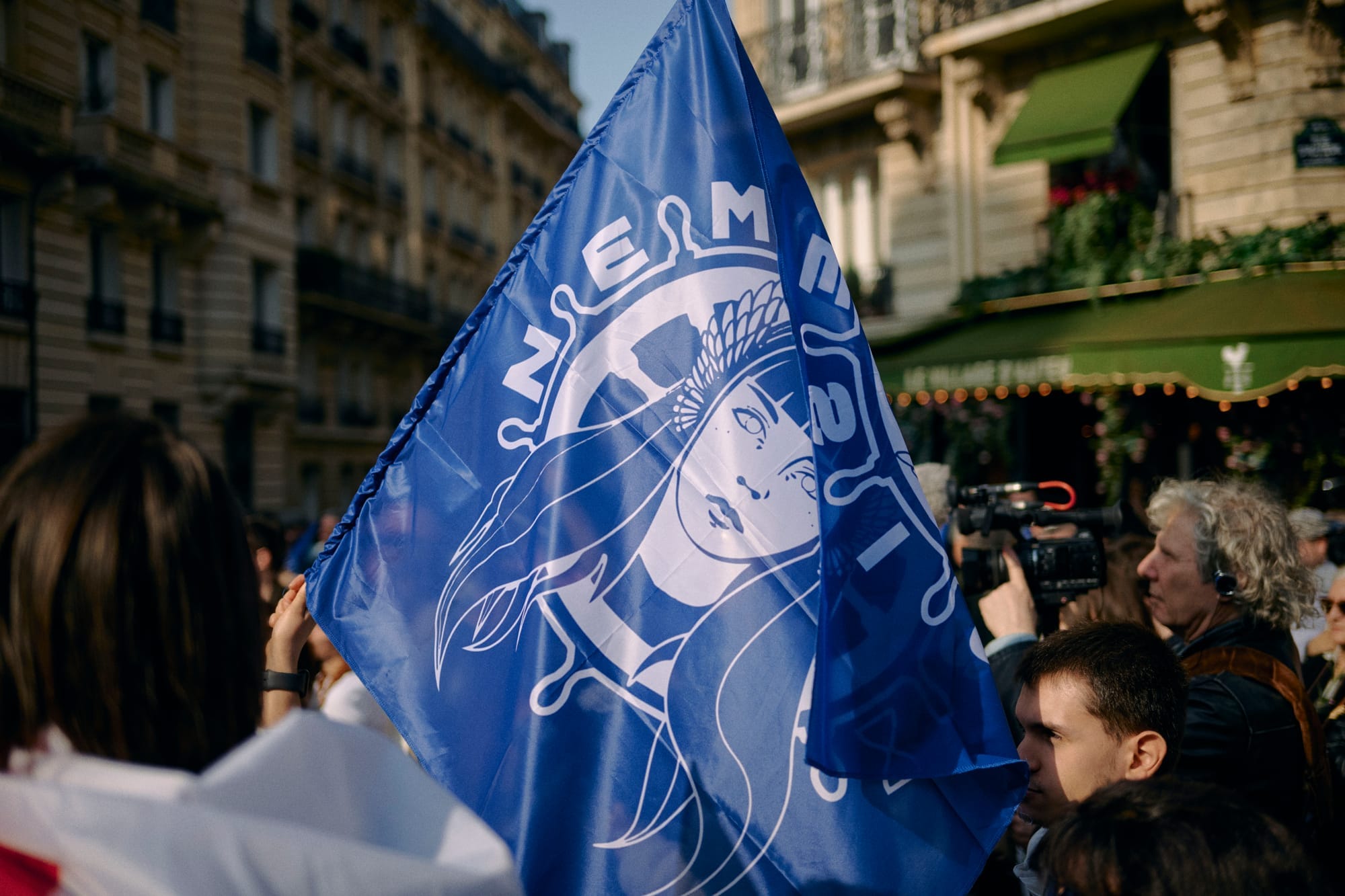
In one photograph posted on social media, Cordier looks off into the distance. Her long hair is flowing down her shoulders. Her left hand is placed on her hip; with her right, she rests an assault rifle on her shoulder. Her sweater is emblazoned with an image of Joan of Arc, a French heroine and warrior who has become an icon of far-right groups for her role in repelling foreign “invaders”.
Cordier is a product of these movements. She came up through the far-right, monarchist group L’Action Française, before founding Némésis in 2019. In an interview with Le Monde, Cordier said she was inspired to found the group by “an article about a young woman being raped in her own garden by a migrant”.
“Némésis was effectively incubated like a start-up,” says Léane Alestra, an author and feminist activist who has been studying the group’s evolution over the past six years. “Their project was conceived within far-right circles. They were supported, funded, given media training, over a long period of time with the aim of creating a direct counterpoint to the feminist #MeToo movement.”
Anti-fascist groups had noted Némésis’s increasing presence in Lyon in the years preceding Deranque’s death. Local anti-fascist activist Tatiana Guille says the city has been “a testing ground for the far right” in France, where more than 100 instances of far-right political violence have taken place since 2010.
Collectif Némésis burst onto the scene in dramatic fashion in 2019, infiltrating a feminist march against gender-based violence in Paris and carrying placards denouncing “foreign rapists”.
Forcing themselves into feminist gatherings and co-opting feminist marches has been their trademark move ever since, allowing the group to amplify its reach despite its relatively small numbers (Némésis has about 200 members).
“They need to vampirize the feminist movement,” Alestra says. “Otherwise, they don’t exist.”
The group thrives on provocation. In 2023, they posed for World Hijab Day, which they call “No Hijab Day”, on the steps of the Sacré-Coeur cathedral in Paris. They do not take a position on most feminist issues, like equal pay or abortion, which public opinion polls show is widely supported in France. Instead, the group’s main focus is violence against women and girls, and only incidents perpetrated by non-white men or immigrants.
And while Deranque’s death has placed far-left violence in the spotlight, the rise of political violence from the far-right in France in the past decade has been far more deadly. The toll has been borne by non-white men, the very group targeted by Némésis activists. Far-right groups or men with racist motives have been responsible for the murders of six non-white men since 2022, according to researcher Isabelle Sommier at the Panthéon-Sorbonne University in Paris.
During their high-profile interventions, the collective relies on men like Deranque for “protection”. Young men from far-right, neo-Nazi and neo-fascist groups have physically surrounded the Némésis protestors as they enter feminist or left-wing gatherings. Sometimes, however, the collective has been given state protection. When Némésis attempted to join a march in Paris in 2025, they were escorted by France’s official riot police.
But as “warriors” themselves, Némésis activists also see themselves as protecting men like Deranque. “Our role today is to defend our men, our white males,” Cordier said in 2020.
Alestra explains the inherent paradox between targeting immigrant men and ‘protecting’ white men as follows: “In Nemesis’s mind, white women’s bodies belong to white men. That’s why there’s no contradiction in the fact that they denounce some perpetrators but not others. In their worldview, as white women, we owe things to white men. And conversely, the rapist can only be a non-white man.”
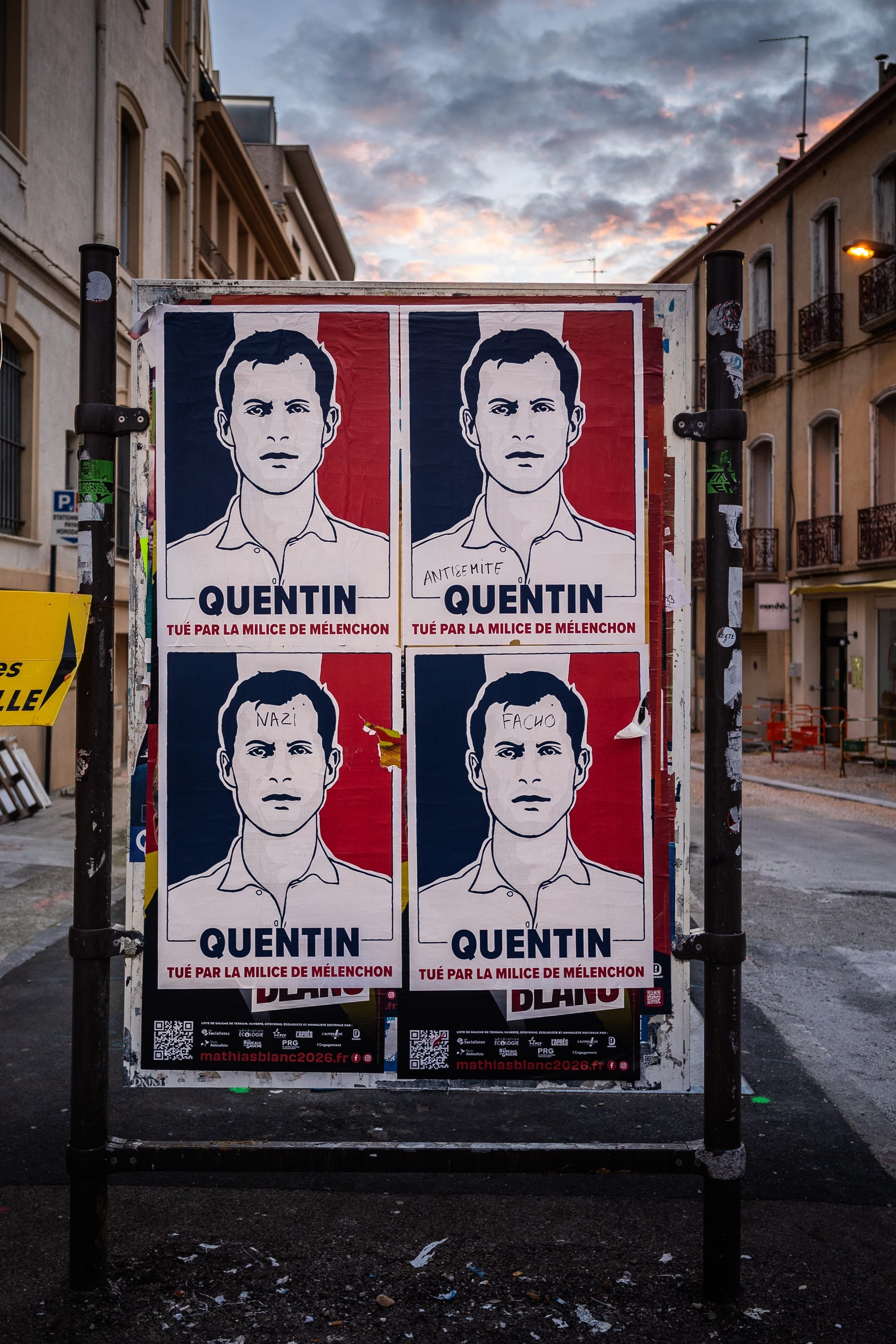
Némésis activists have an outsized presence in the local media landscape, in part due to their provocative publicity strategy. But it’s also due to the efforts of two French billionaires to shift public discourse towards the far right ahead of the country’s presidential election next year.
The collective is given regular platforms on television channels, radio stations and in magazines owned by Vincent Bolloré, a traditionalist Catholic who made his fortune in shipping. Cordier has appeared at events put on by Bolloré and Pierre-Édouard Stérin, another Catholic billionaire and a libertarian financial backer of the far right, who has said his “priority areas for action in France” include “having more babies of European descent”.
Stérin has financed “project Pericles”, whose aim is to ensure the election of the far-right in presidential elections next year. A March poll shows the far-right National Rally retaining its place as France’s most popular political party.
The media attention around Deranque’s killing has brought increased scrutiny to Némésis and its links with neo-Nazi groups amid growing calls by French lawmakers for the group to be dissolved.
As of last year, the collective had begun to publicly move away from its most extreme connections, but the circumstances of Deranque’s death have led to new revelations about the group’s associations and financing, and calls for Némésis to be dissolved by the authorities. But Alestra warns that dissolving Némésis could pose “a major risk” for feminist groups that are not associated with the far-right. “It could open the door for the dissolution of other feminist movements,” she says.
In April, the French Libération newspaper revealed that donations to Némésis were tax deductible due to the collective’s status as a charitable organisation, causing outrage on France’s left. Prime Minister Sébastien Lecornu said he has instructed tax authorities to look into the matter.
Alestra says these kinds of investigations should have taken place sooner. “We had to wait until the death of Quentin Deranque – in other words, until it affected men – for investigative work to start being carried out,” she says.
After taking part in the marches in homage to Quentin Déranque, Némésis didn’t try to infiltrate the annual International Women’s Day demonstrations on 8 March as they usually do. Instead, they held a modest gathering on the other side of town alongside a clutch of far-right politicians.
But at their recent appearance in London during the far-right Unite the Kingdom protest, once again, Cordier portrayed Némésis members as victims of immigration, the state and anti-fascists. Standing on stage, she said the activists were “alone against a system that wants to destroy our Christian civilization; alone against a system that sacrifices European women on the altar of ‘living together’”.
On Instagram, Némésis wrote: “This is just the beginning”.
Representatives of Némésis, including Cordier, did not respond to a request for an interview or a list of questions for this article.
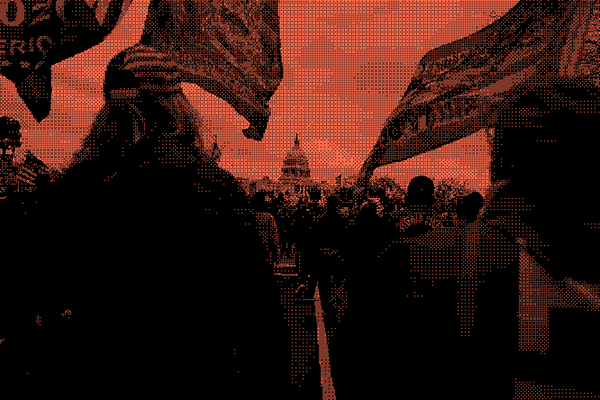
Lead photography by Hans Lucas. Edited by Charlie Brinkhurst-Cuff and Anastasia Moloney
Lead photography by Hans Lucas. Edited by Charlie Brinkhurst-Cuff and Anastasia Moloney