A rift is growing between women
The far right is weaponizing women’s very real concerns for their safety, writes Natasha Walter in a new book. But what’s worse is that we have begun to care less about refugee women
Editor’s note: Natasha Walter is a British feminist writer and human rights activist, whose latest book, Feminism for a World on Fire, asks how women can defend their rights and freedoms in these dangerous times. The extract below, taken from her book, spoke to our Far Right edition as it plainly articulates the dehumanizing ramifications of far-right rhetoric on refugee and immigrant women – Charlie Brinkhurst-Cuff, Lead Editor
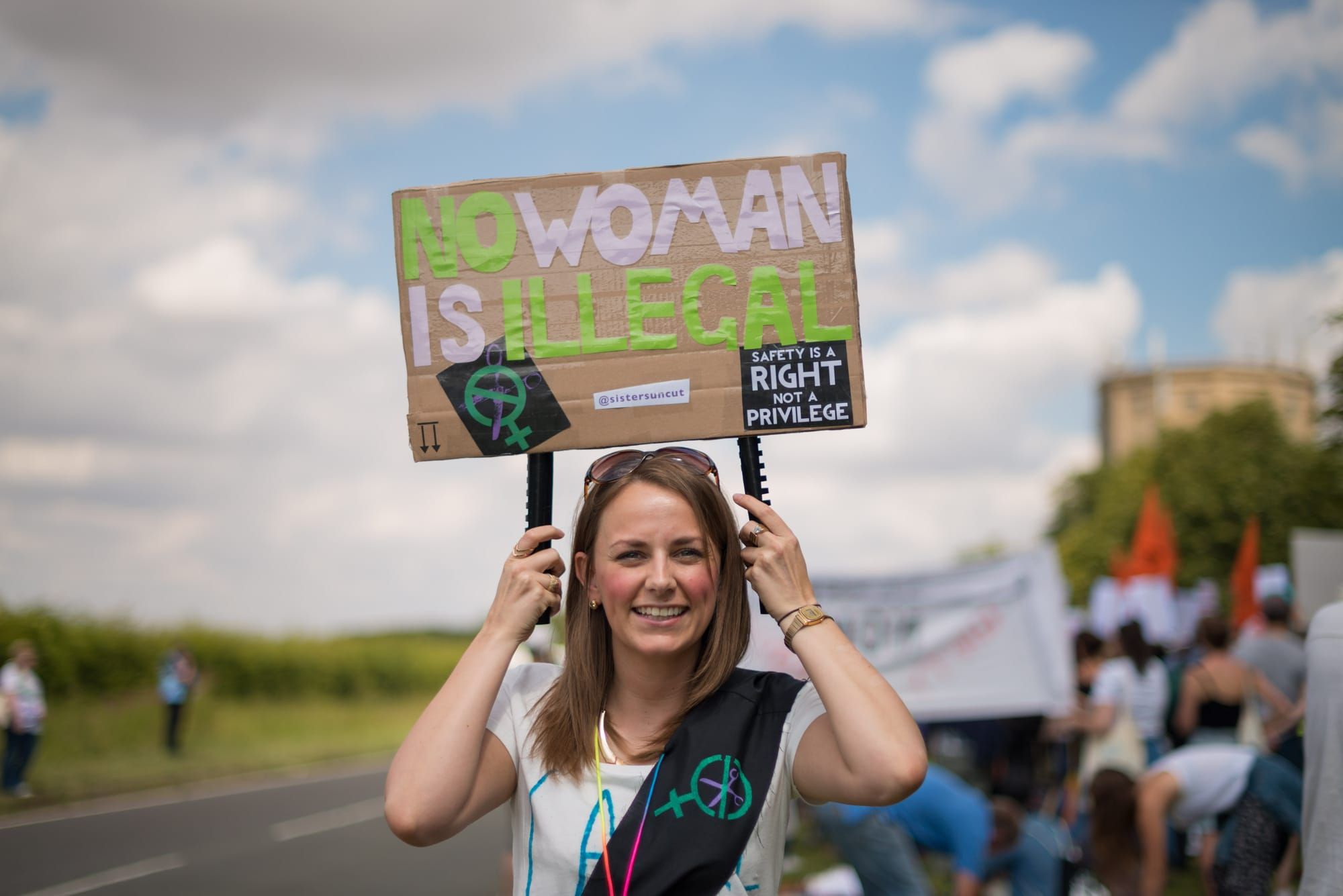
In 2014, I stood outside a women’s detention centre with hundreds of people, calling for the release of migrant and refugee women. There were reporters there, politicians, actors, writers and refugee women. When that detention centre was closed to women, I took it as a sign that solidarity could create genuine change.
But soon another detention centre for women was opened in the north of England, and punitive policies against refugees ramped up. Women who took irregular routes to come to Britain were told that they would never be eligible for permanent refugee status; instead, they would be condemned to a lifetime of insecurity. Supporters of migrant women demonstrated again, set up more petitions, met with more Members of Parliament. People were tired, but kept going, because there was always the faith that it was still possible to build a society based on greater connection and empathy.
For me, one of the most heartbreaking shifts of these recent years has not come from governments or politicians, however harsh their policies and rhetoric have become, but from the growing realization that it is becoming harder and harder to build connections among women at the grassroots. Right now, the very genuine fears and concerns of women are being used as the basis for ideologies that are not bringing us together, but dividing us.
Many women’s horizons are shrinking. The challenges facing women do not always lead into a desire for openness. They also lead to a desire to build barriers. Behind those barriers, women hope to feel safer, but these walls are only leading to a more bitterly divided world.
The rise of the far right across the world is still more correlated with male than female support, but it is increasingly cloaked in a kind of rhetoric which takes women’s justified anger at violence and poverty and channels it not against those with the power to shape the conditions in which inequality and violence thrive, but against migrants and the marginalized.
The fallout from this xenophobia for women who are trying to cross borders is real. This can sometimes flare into violence against them: when protests against migrants erupted in Britain in 2025, it was reported that a Sikh woman was raped by two men who told her to “go back your country”.
It was unsurprising and deeply depressing to hear from refugee women that they were feeling scared to leave their homes. One black refugee woman told a reporter, “I feel very unsafe, of course. I don’t feel safety at all. I just have to take one day at a time. You don’t want to leave your home. Your freedom ends up being restricted by fear.” But even when this growing xenophobia does not flare into threats or violence, it can result in a kind of casual dehumanization that erodes ordinary empathy and connection.
Vicky Marsh is a 62-year-old woman who has worked in services for survivors of violence in the north of England for over 40 years. I’ve known her for more than 20 years, and when I last met her, at a meeting in Parliament, she was feeling ground down.
“It’s harder than ever,” she said, “all the systems are so rigid and the safety nets have gone.” Marsh works with migrant women who have no right to claim state welfare. That means that they can’t go into domestic violence refuges, which are reliant on women’s welfare payments. She has seen an increasing lack of empathy for these women, even among those working for domestic violence charities. “I think that there is this sense of scarcity – that there isn’t enough to share. The anger about immigration has an effect. People don’t want to see migrant women in the same way they see other women. They dehumanize them. They only see their immigration issues.”
This growing dehumanization makes it harder and harder to build solidarity across borders. So many women are struggling with the impact of conflict and state repression. But when women try to leave places where they are at risk, they can face further violence and oppression. A research project carried out in 2020 by the charity I worked for found that nearly half of the refugee women who sought safety in Britain had experienced violence on their journey.
These harsh borders exert a cruel cost on women. In Tunisia, for instance, the European Union is funding security forces that have been shown to be committing widespread sexual violence against migrant women in order to try to prevent them moving across to Europe. “We’re being raped in large numbers; they [the national guard] take everything from us,” one migrant woman from Côte d’Ivoire, who had made the long journey through the Sahara in search of safety and opportunity in Europe, told a reporter in Tunisia.
I asked the filmmaker Sara Mokhavat, who is living at the sharp end of rising oppression in Iran, why she doesn’t leave her country. She said sadly: “If I went elsewhere, how could I work? I’m an artist, my soil is here, my home is here, my art grows out of my soil. But also, I see what Europe, America are doing now. They see that our lives are hard and they don’t want to let us in because they think they will be stuck with us.”
In 2025, one of her films was screened at a festival in Italy, and the team who worked on the film applied for visas in order to attend. The men were allowed in by the Italian government, but the women weren’t. “They see how hard women’s lives are in Iran and they think that we won’t go back. It showed me, nobody wants to understand you or respect you.”
This is an edited extract from Feminism for a World on Fire by Natasha Walter, published on 7 May 2026 by Virago.
Lead photography by Velar Grant via ZUMA Wire. Edited by Charlie Brinkhurst-Cuff and Eliza Anyangwe
Lead photography by Velar Grant via ZUMA Wire. Edited by Charlie Brinkhurst-Cuff and Eliza Anyangwe