In Brazil, asking for child support can come at a dangerous cost
Child support claims are rising rapidly in Brazil. But for some women, demanding support for their children can provoke threats, abuse and even femicide
Belo Horizonte, Brazil – Sixteen years ago, Brazilian model and mother Eliza Samudio was kidnapped and murdered by two men on the orders of her former partner in a domestic violence case that gripped Brazil and put the spotlight on the high rates of femicide in the South American nation.
Her former partner, Bruno Fernandes de Souza, a well-known professional football player, was sentenced to 22 years in prison in 2013 for ordering the killing of Samudio, who was the mother of his child.
A year before she was murdered, Samudio had gone to the police to report that Souza had pressured her to have an abortion and threatened to kill her if she refused. Prior to her killing, Samudio had also filed a paternity lawsuit and sought child support for their son. After her death, DNA testing confirmed Souza was the father, and a court recognized their son’s right to child support.
During the court case, the judge in her sentencing remarks explicitly referenced the paternity and child support disputes saying that they did not justify Samudio becoming the “target of such barbaric crimes.”
Her case underscores how conflicts over child maintenance can be part of a broader pattern of coercion and threats against women and an underlying factor in domestic violence, and in the case of Samudio, be fatal.
In an online tribute in June 2026 marking the 16th anniversary of the murder of Samudio, her mother wrote on Instagram: “What breaks a mother’s soul is knowing that Eliza cried for help … but the invisibility that society imposes on violated women swallowed her cry.”

‘We’re not looking at the situation as a whole’
Increasing numbers of women in Brazil are taking legal action to claim child allowance. Government figures show child support disputes are among the most common family court cases in the country, rising by 63.4% between 2020 and 2025, and reaching 410,298 in 2025. Lawyers say the increase reflects greater awareness among women of their rights and better access to information.
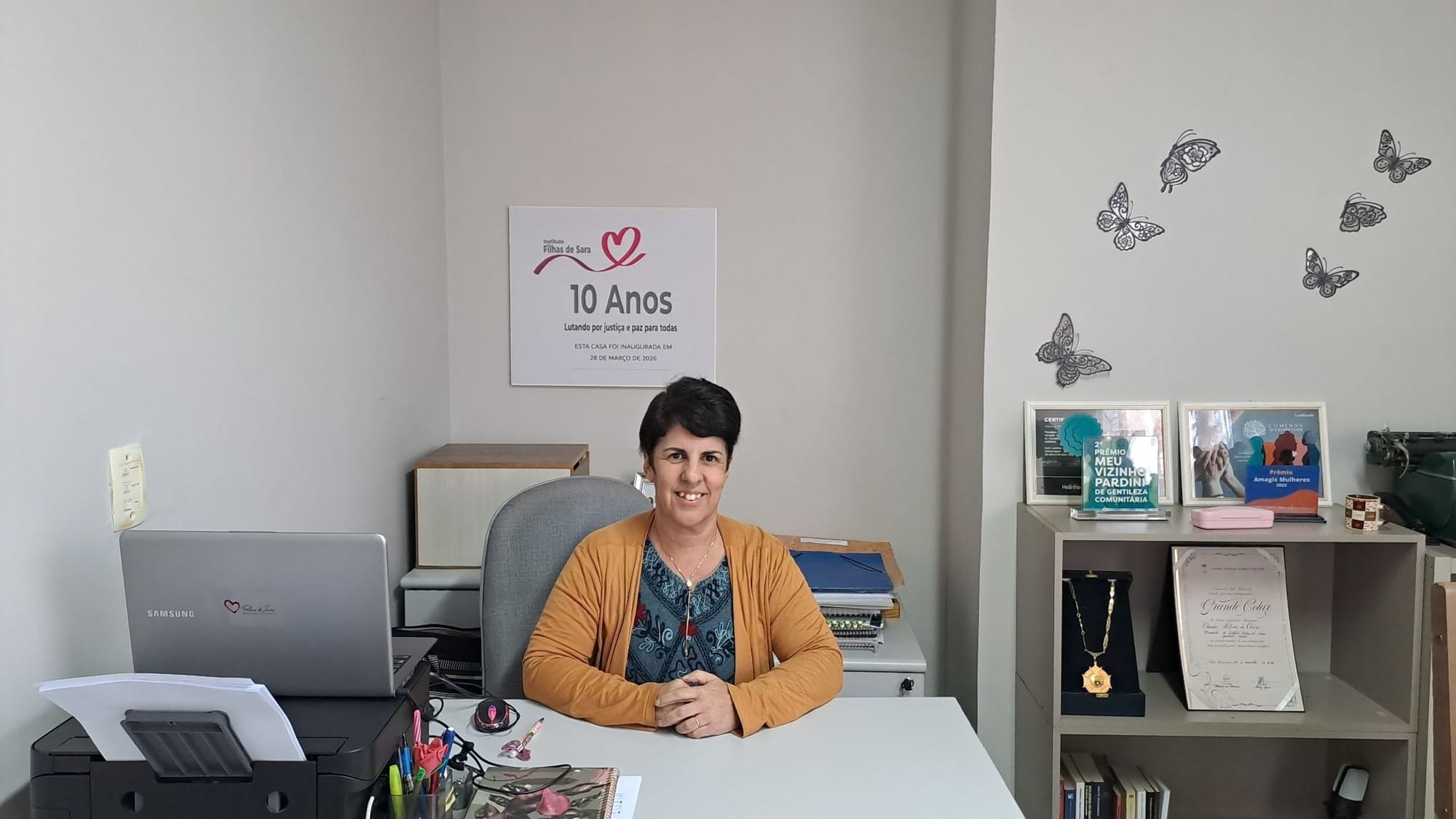
But seeking child support in the country can put women at greater risk. Claudia Oliveira, director of Filhas de Sara, a women's rights organization in the state of Minas Gerais that provides free legal, psychological and employment support to survivors of domestic violence, says violence “often intensifies” when women ask for child support.
Four women are killed every day in Brazil, with about 60% of femicides committed by current or former intimate partners. Research shows that the first year after a woman leaves an abusive relationship is the period when she is at greatest risk of being killed. And it is often during this time that women take legal steps to seek child support.
Yet Brazil has no national data on whether child support disputes are a factor in domestic violence or femicide cases, making the connection between the two difficult to quantify.
According to Gabriela Campos, a legal researcher, the lack of data means warning signs in domestic violence cases can be missed.
“Child support is often seen as a matter of interest concerning children. So it’s common for domestic violence to be disregarded in these cases … we’re not looking at the situation as a whole,” says Campos.
However, a review conducted by Fuller of Brazilian media reports over the past two and a half years offers some insight into the largely unexplored link between gender-based violence, femicide, and child support disputes. The review identified a total of 45 incidents where child support was a direct or indirect cause of violence from 2024 until June 2026.
“Threats, intimidation and harassment often increase when child support is requested,” says Oliveira. “Many men see child support as money for the woman to spend on herself, on makeup or other things. The request often becomes another source of conflict and control,” adds Oliveira, whose organization has supported about 600 women, most of them involved in child support disputes, over the past decade.
Most recently, in March, a mother, Leidimar Oliveira Guimarães, was murdered in the southwestern state of Bahia after demanding child support for her two teenage children from her ex-partner. Five days later, another child support case in the same state sparked outrage when a judge questioned a domestic violence survivor's request for temporary financial support, suggesting it could make her “idle” and remarking that “nobody wants to work anymore”.
Judicial officials have also been known to criticize women for seeking child support. In Brazil’s southeastern state of Espírito Santo, a domestic violence survivor who endured abuse for 20 years went to court seeking child support in 2024. She was told by a prosecutor that she should stay with her abuser. “You should stop making a fuss and stay together for the rest of your lives,” he said. The case was later reported to Brazil's National Human Rights Council (CNDH) and the National Council of the Public Prosecutor's Office (CNMP) as an incident of institutional violence.
“Men pay when they want, how they want, and only if they want,” says Magie Vila, a family lawyer who works with domestic violence survivors at Maria Felipa, a women's legal advocacy organization and temporary shelter in Brazil's southeastern Minas Gerais state, who has been through her own divorce and child support battle.
‘He called me a thief’
At the Filhas de Sara support centre, Rosa, a domestic violence survivor and mother of two whose name has been changed for safety reasons, says she spent nearly three decades living with psychological abuse and physical violence that included her husband pouring hot coffee over her and slapping her son.
Her husband would also routinely withhold money, even for basic household needs and food. “I thought it was normal,” she says. “I kept telling myself he was just nervous.”
In 2020, lawyers at the centre first helped Rosa obtain a protective order under the 2006 Maria da Penha Law – named after a survivor of domestic violence – before filing for child support.
Brazilian courts issued 964,480 protective orders in the last year. Yet protection does not always stop retaliation. About 13% of femicide victims in Brazil had an ongoing emergency protective order at the time of their murder.
For Rosa, seeking child support brought new forms of abuse. Rosa says her ex-partner responded with insults and humiliation. “He called me a thief. A slut. Every name you can imagine," she says. Oliveira says this pattern is common.
In 2021, a court ordered child support equivalent to 40% of Rosa's former husband's income for their two children. But last November, he stopped paying. For six months, no money arrived. It was only after lawyers at Filhas de Sara successfully petitioned the court to deduct child support contributions directly from his retirement income that the payments resumed.
“If I didn't have free legal support, I wouldn't know what to do and probably wouldn’t be here today,” Rosa says.
But for Miguel Fontes, head of Promundo, a Brazilian non-profit working globally to engage men and boys to end violence against women, enforcement alone can’t solve an issue rooted in how boys are socialized. “It’s a cultural problem,” he says.
“One aspect of performative masculinity is not paying child support, not participating,” Fontes says. “We need to create spaces for men to reflect on these norms and understand that care and co-responsibility are part of fatherhood.”
‘Money becomes another weapon’
Brazilian law does not set a fixed amount for child support, and payments are determined by the child’s needs, including food, housing, education and healthcare, and a parent’s income. Failure to pay child support is recognized as a form of economic and psychological violence against women.
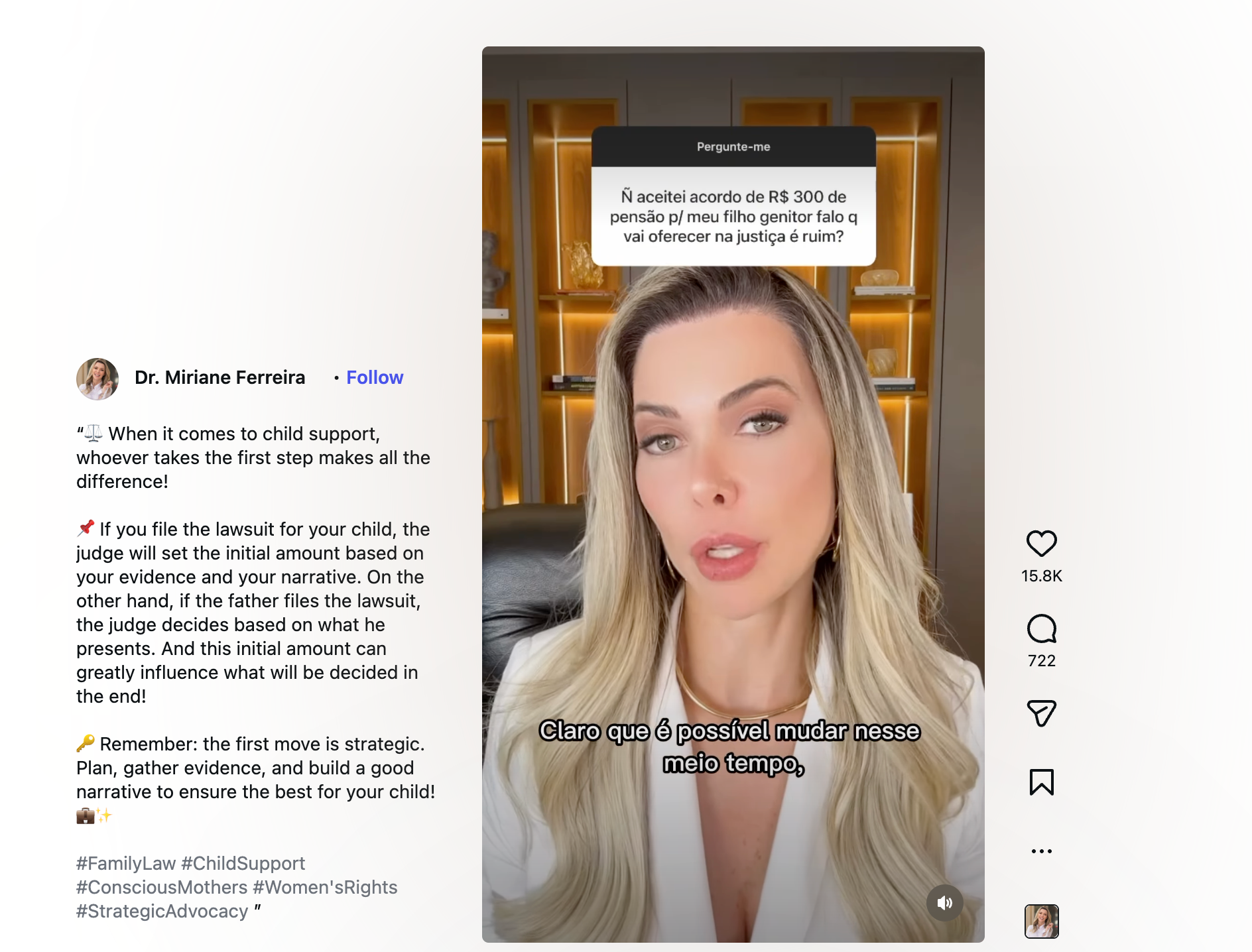
Brazilian family lawyer Miriane Ferreira, who has 1.9 million followers on Instagram, gives online legal advice to women seeking child support. She says jail remains one of the few effective enforcement mechanisms. “When a judge orders imprisonment for unpaid child support, the money suddenly appears,” says Ferreria, adding that she receives around 200 messages a day on Instagram from women asking for guidance.
The challenges that come with seeking child support have become so common in Brazil that it even became a storyline in the country’s popular soap opera Vale Tudo (Anything Goes) in 2025. After a female character used a government app to request child support on the television show, around 270,000 women accessed the service. In Rio de Janeiro alone, demand jumped 300%, resulting in 1,148 legal assistance appointments.
But obtaining a child support order often means more conflict. Even after courts award the right, women remain trapped in what Ferreira describes as “gender lawfare” – the use of legal proceedings, intimidation and economic pressure to punish women for pursuing their rights.
One of Ferreira’s clients sought child support and recognition of her share of the couple's assets after leaving an abusive relationship. According to the lawyer, the retaliation began almost immediately. The former partner bombarded the client with messages, accused her of harming their child and pressured her to accept a settlement far below what she was legally entitled to. “She already had legal protections,” Ferreira says. “But she's still terrified of him.”
Ferreira says fathers tend to use the legal system as a form of retaliation. “There are men who only pay child support after enforcement proceedings begin so the mother spends more money and time on lawyers,” she says. “Women spend years going back and forth to court especially when fathers dispute paternity, hide income, appeal rulings or repeatedly file new legal actions.”
In some cases, Ferreira says, violence and pressure from fathers is so intense that women abandon child support claims altogether. Her client, despite securing a protective order and a favorable ruling, is now considering accepting less than she is legally entitled to in order to end the conflict. “Money becomes another weapon,” Ferreira adds.
Not being able to claim child allowance can exacerbate financial dependence and vulnerabilty. “A woman who lives in a mansion and enjoyed a comfortable life during marriage may, after separation, face significant financial instability,” says Ferreira, highlighting the economic challenges women often face post-separation. “Financial dependence is the gateway to abusive relationships,” she adds.
‘The abuse intensified’
The Maria Felipa women’s rights organization has seen this dynamic play out repeatedly. One example is Joana, whose name has been changed to protect her identity. The 41-year-old cleaner and mother of three separated from her husband in 2012, but only secured child support four years later, after going to court to finalize the divorce and demand payments.
Although Joana secured child support and a protective order in 2016, financial disputes remained a source of conflict. According to the organization’s co-founder, Isabela Corby, her former partner repeatedly undermined efforts to rent out or sell the family home by intimidating prospective tenants and buyers, leaving the property vacant for years.
He had previously climbed over Joana’s property wall to threaten and assault her, forcing her to move to another city. “The abuse intensified after the divorce and child support proceedings,” Corby says.
For women’s rights advocates, Joana’s case highlights how child support disputes and domestic violence are often treated as separate matters, with prosecutors and judges failing to see the links between them.
“Providing protection to women in a fragmented way is a mistake,” says Marina Ganzarolli, head of Me Too Brazil, a non-profit supporting sexual violence survivors. “A woman shouldn’t have to move between different courts and services to access her rights.”
Nearly 20 years after the Maria da Penha Law was passed, Ganzarolli says expanding specialized domestic violence courts are part of the solution but there is a lack of political will and investment. “Not only can Brazil protect mothers asking for child support, it would be relatively straightforward to do,” she says. "The law is already there. What’s missing is its full implementation."
As for Samudio’s son, who is now 16 and is being raised by his maternal grandmother, he is still fighting to receive some $18,000 in unpaid child support he is legally owed from his estranged father. In an interview with local media, the teenager’s godmother said that he would be willing to give up the child support claim if his father revealed the whereabouts of his mother’s remains, allowing his family to finally bury her. So far, Souza has not publicly responded.
Co-published with Mídia Ninja
To explore the link between femicides and child support disputes, we conducted a qualitative manual media review using Google News in Portuguese with three keywords: child support, violence, and femicide.
In total, 45 cases were identified covering 2024, 2025, and up until June 2026. Each case was coded by date, location, and type of violence (femicide, attempted femicide, or other forms of gender-based violence).
Cases were further categorized into two groups: those in which child support disputes were clearly reported as a direct cause or triggering factor for violence, and those in which child support and violence were mentioned in the same case, but without a clearly established causal link.
In 2024, 13 child support requests were reported as a direct trigger for violence or femicide, while one was mentioned together without a clear causal link. These cases included four femicides, five attempted femicides and five incidents of violence.
In 2025, 12 child support requests were reported as a direct trigger for violence or femicide, while six were mentioned together without a clear causal link. These cases included five femicides, two attempted and 11 incidents of violence.
In 2026, nine child support requests were reported as a direct trigger for violence or femicide, while four were mentioned together without a clear causal link. These cases included two femicides, one attempted and 10 incidents of violence.
This is not an exhaustive dataset and reflects only cases reported in Brazilian media and captured through keyword-based manual search. It likely underrepresents the full scale of incidents due to gaps in official data, reporting practices, and case classification.
How we made it
Kilometres travelled: 9,570 km
Countries our sources are in: Brazil
Cold emails sent: 52
Hours of recordings: 16
Number of interviews: 15
Words written: 2,352
Lead imagery by Gabrielle Smith. Edited by Anastasia Moloney and Charlie Brinkhurst-Cuff
Lead imagery by Gabrielle Smith. Edited by Anastasia Moloney and Charlie Brinkhurst-Cuff