In US midterms, affordability beats abortion for Georgia's student voters
The governor’s race between Keisha Lance Bottoms and Rick Jackson is a toss-up. We asked University of Georgia students about the issues that matter to them in 2026

This campus dispatch is a collaboration between Fuller and Rewire News Group.
Athens, Georgia - Four years since Georgia’s abortion ban took effect, students say they are not prioritizing reproductive healthcare in the state’s 2026 election.
As University of Georgia students decide whether to vote for Democrat Keisha Lance Bottoms or Republican Rick Jackson as the state’s next governor in the 3 November midterms, affordability, education and the growing role of artificial intelligence have taken precedence.
“They’re like, why should I care about a woman’s right to choose if I can’t afford having to pay for my utilities or be able to pay for gas and such,” said Adi Singh, 19, a finance major who is involved with Young Democrats of UGA and Athens-Clarke County.
It "feels kind of wrong,” he added.
With early voting underway in Georgia, the polls have Jackson and Bottoms in a statistical tie. Georgia has the South’s youngest population, which means young voters — among other important groups, like black Georgians — could influence who controls the governor’s mansion and general assembly.
Even a small shift in partisan control of the state could have a big impact on reproductive legislation and access to abortion services, regardless of whether students consider that issue in casting their ballot.
Georgia's abortion ban
Georgia was one of the first states to adopt legislation restricting reproductive rights after Roe v. Wade was overturned by the US supreme court in 2022.
Governor Brian Kemp signed Georgia’s Living Infants Fairness and Equality (Life) Act into law in 2019. It was quickly struck down as unconstitutional in court, but reinstated once the supreme court overturned Roe.
The law, known as a “heartbeat bill,” bans abortion once fetal cardiac activity is detected — usually around six weeks into pregnancy. That’s before most people know they are pregnant. What’s being detected at this early stage isn’t a heartbeat— it’s electrical activity in the fetal pole, before a fetus has developed.
Exceptions to the law include cases of rape or incest reported to law enforcement, and medical emergencies that threaten the life of the pregnant person.
Two Georgia women died in the weeks after the law was enacted because they could not receive timely abortion care. According to ProPublica, both Amber Nicole Thurman, 28, and Candi Miller, 41, died of complications from an incomplete miscarriage after taking abortion pills — rare consequences deemed preventable by a state committee of experts in maternal health.
In Thurman’s case, the doctors were concerned that doing a dilation and curettage, or D&C, procedure to clear her uterus would expose them to prosecution for violating the ban. Miller was in frail health when she got unintentionally pregnant but did not seek medical care when she developed complications after taking abortion pills; her family said she made this a choice in light of the new ban. The autopsy also found a deadly combination of painkillers in her system.
UGA student Agni Athreya, from the Johns Creek suburb of Atlanta, has been involved with various reproductive healthcare and LGBTQ+ policy advocacy groups, such as the Amplify Georgia Collaborative and Georgia Equality, since she was in high school. Now a senior and a computer science major, she remains involved in abortion advocacy on campus.
“When Roe got overturned everyone was in such despair and dismay over it,” Athreya, 21, said.
Yet abortion ranked ninth most important among 12 issues identified by Georgia voters in a June 2026 poll conducted by UGA’s school of public and international affairs survey research center. Cost of living ranked number one.
And among young people aged 18-29, just 2% said abortion was their top concern.
Both gubernatorial candidates in Georgia have talked about reproductive healthcare on the campaign trail, but neither has made abortion access a substantial part of their campaign.
Bottoms, former mayor of Atlanta and senior advisor to President Joe Biden, has pledged in her CARE Plan for a Healthier Georgia to repeal the 2022 ban. Jackson, a healthcare CEO for a national company, has promised to uphold it.
Despite the ban, Georgia is one of four states in the South where some form of abortion access is still technically available. Alabama and Tennessee have outlawed abortion entirely.
“Even if you have the legal choice, like the legal option to an abortion, that doesn’t mean people can actually access it,” Athreya pointed out.
She added that other roadblocks for pregnant patients — like laws requiring minors to get parental approval for an abortion and online health misinformation — effectively turn Georgia’s law into a near-total ban.
Rural Georgians also face geographic challenges in accessing care. There are 13 verified abortion providers in Georgia, many of them in metro Atlanta. About 95% of Georgia’s counties do not have an abortion clinic, according to Amplify Georgia.
Most abortion clinics provide other reproductive health services, including sexually transmitted infection testing, menopause treatment, and postpartum care. A recent study from the Commonwealth Fund found that states that have restricted abortion have fewer maternity care providers. In Georgia, 44% of counties are maternity care deserts, according to a March of Dimes report.
Athreya is the president of Unite for Reproductive and Gender Equality (URGE) at UGA. Yet she told Fuller and RNG that her priorities going into this election season are Flock camera surveillance (AI-powered license plate readers), data centers, artificial intelligence regulation, and food insecurity.
“I can’t think about starting a family if I don’t have these basic needs met,” Athreya said.
Abortion and affordability
Alexandria Criner is a sophomore from Douglasville, a city about 20 miles west of Atlanta, studying political sciences and religion. She said reproductive rights are important to her, especially as a woman of color.
Black women in Georgia are more than twice as likely as white women to die from pregnancy-related deaths, according to the state department of health.
Georgia has the fourth-highest number of maternal deaths in the US. Much of northeast Georgia — where UGA is located — has little access to maternity care. St Mary’s Health Care System, a major healthcare provider in northeast Georgia, closed its obstetrics and gynaecology practice in Lavonia, a rural small town, in 2025 and consolidated labor and delivery services into the main St Mary’s hospital in Athens, about 45 miles away.
These factors may make it harder to get an abortion, but, Criner said, abortions are still occurring.
“Abortions will happen,” she said. “It does not matter whether they are legal or whether they’re not legal. People are going to find a way. If they do not want a child, they will not have a child.”
However, like other Georgians, Criner said cost of living is her most important issue this election.
“Me and everybody else,” she said, adding that affordability affects everyone.
With rising gas prices, textbook costs, grocery bills, and apartment rent, students interviewed will be voting with the cost of living in mind. Other priorities included healthcare costs and access, AI and data center regulation, homelessness initiatives and lack of strict public safety regulations with Flock camera surveillance. (Flock’s headquarters is in Atlanta.)
Youth turnout could be decisive
Many students told Fuller and RNG they felt Bottoms and Jackson are campaigning well on issues they care about.
Bottoms lists expanding healthcare access as the top issue on her campaign website. Affordability ranks first on Jackson’s action plan; healthcare comes seventh. On his website, Jackson suggests that his experience as a healthcare CEO would better position him to increase access to, and affordability of, healthcare.
“Young voters could play a major role in Georgia’s November midterm elections,” said Georgia Gwinnett College political science professor David Felsen in an October interview with Georgia’s WBS Radio.
He added that turnout specifically in the 18-25 age range could make a “huge difference”.
During the 2022 midterms, just 25% of registered, active Georgia voters aged 18-24 voted, according to the Georgia Secretary of State Data Hub. Overall turnout for all age groups statewide was significantly higher, at 50%.
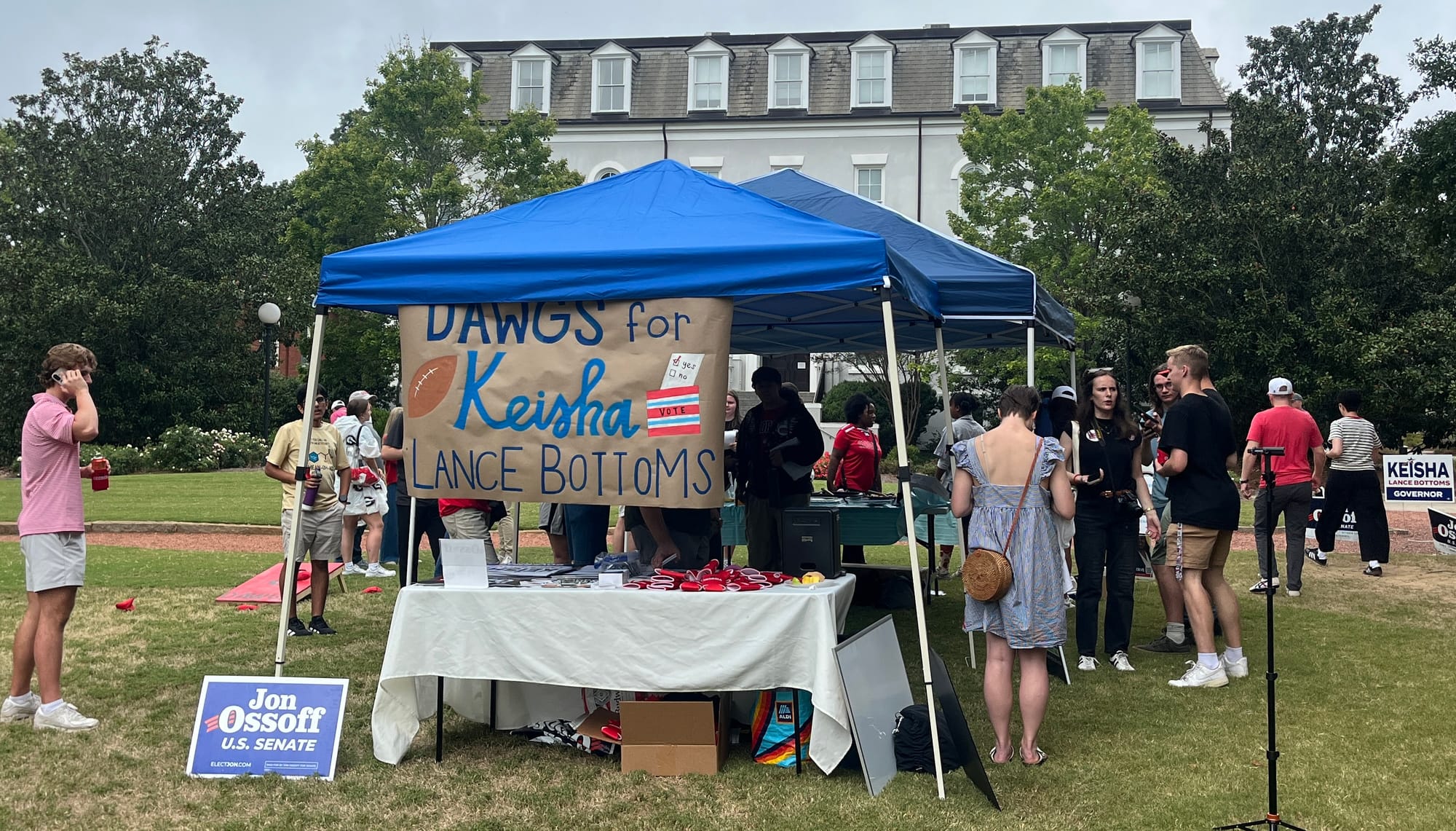
Both Jackson and Bottoms have attended UGA football tailgates. Bottoms held a joint campaign rally in Athens with Senator John Ossoff in September 2026. Both students and residents attended, and Bottoms pledged to lower grocery costs and work to expand Medicare.

Still, some students said they felt the candidates aren’t doing enough to engage their demographic.
“I think it’s a missed opportunity to not cater towards [young voters] because it’s an important group,” said Henry Hamilton, a sophomore studying finance, financial planning and law. “It’s one that’s going to stay around.”
Candidates aren’t talking much about reproductive healthcare — and voters don’t seem to be asking them to. In a town hall debate on 6 October, hosted by the independent TV station Atlanta News First, audience members asked questions related to gas prices, affordability, data centers and Flock cameras. Neither abortion nor reproductive healthcare came up.
Carter Ray, a second-year political science major, said UGA students do care about abortion — just, perhaps, not right now.
Ray, who grew up in a “civically engaged household” and participated in political organizations on campus, suggested that reproductive healthcare might not be a hot topic this cycle because substantive change in policy would only be possible if the Democrats won both the governor’s mansion and a majority in the General Assembly.
That hasn’t happened in Georgia since 2002.
“I don’t think that this election can have a significant chance at changing our [abortion] status quo,” Ray said.
Athreya argued that substantive change in reproductive healthcare can stem from other political changes. She said people cannot think about family planning until they have met other fundamental needs, like housing, food security and basic healthcare.
“A lot of it really boils down to if you ask people what is it that you really need right now,” she added.
Christian values on campus
At UGA, Christianity plays a role in campus attitudes about reproductive healthcare. The school has more than 35 registered student organizations that cater to Christian values or foster Christian community, according to UGA records.
Dharshine Jay, president of Young Americans for Freedom at UGA — a national conservative Christian organization that promotes “traditional” family values — supports Georgia’s current abortion policy.
She argued it should be more strict, claiming human life either “has intrinsic value or it doesn’t”.
However, Jay, a third-year student, said she votes with a politician’s character and values in mind, not necessarily just their campaign promises. She campaigns for her group on campus, handing out pins with the phrase “pro-freedom, pro-life” and stickers reading “unborn lives matter”.
Grant Ellner, a third-year student, from the city of Peachtree Corners, about 20 miles northeast of Atlanta, is a member of the Christian fraternity Beta Upsilon Chi and the Wesley Foundation, a Christian student group and church. As a conservative, he said it would be “very important” for him to live in a place that supports pro-life policy.
Ellner believes voting is an important responsibility. Like Jay, he said that traditional values and the candidate’s “character” are guiding his choice in this year’s election.
But, when asked about the candidates for governor, Ellner mistook Republican US Senate candidate, Mike Collins, as a contender.
“On top of classes right now, maybe it’s not the most prevailing thing in my life,” Ellner said of the race.
In the final two weeks of campaigning, campus groups like the Young Democrats of UGA and Athens and College Republicans are working hard to get more students politically engaged — and ready to vote.
Athreya wants to mobilize students who already care about reproductive healthcare, and educate those who don’t.
“It’s only through conversation that you change culture, Athreya said. “And ultimately that’s the way forward, especially living in the South.”
[cr1]Maia Capuano Blejer is a journalism and international affairs student at the University of Georgia. Edited by Liz Ford and Anastasia Moloney at Fuller and Catesby Holmes and Natasha Roy at Rewire News Group.
[cr2]Maia Capuano Blejer is a journalism and international affairs student at the University of Georgia. Edited by Liz Ford and Anastasia Moloney at Fuller and Catesby Holmes and Natasha Roy at Rewire News Group.