Newsletter: We need to talk about the World Cup
From stadium bans over unpaid child support to players accused of serious violence still on the pitch, football’s moral line remains unclear. Plus, our latest investigation into the far right on PayPal

As a Brazilian journalist who's covered three Fifa World Cups, I love the game. But the time is long overdue for us to talk seriously about football and violence against women.
Fifa does not bar players under investigation, or facing trial, from representing their countries. And this year, at least five players at the tournament have faced or are facing investigations over allegations of rape or sexual violence.
And this isn't only about sexual violence. In Brazil, footballers are also regularly in the headlines for refusing to pay child support, which is recognized by the government as a form of economic and psychological violence against women.
For our Cost of Living edition, out now, I spent two months reporting on what happens when women in my country ask for that money. Lawyers, shelter workers and survivors repeatedly told me that asking for child support is an aggravating factor of violence against women.
Claudia Oliveira, director of Filhas de Sara, a women's rights organization, told me why: “Many men see child support as money for the woman to spend on herself, on makeup or other things. The request often becomes another source of conflict and control.”
Eliza Samudio’s case remains the country’s most infamous example. In 2010, she sought child support after filing a paternity suit against goalkeeper Bruno Fernandes de Souza. Then she was murdered and her body was never found.
Souza was convicted of ordering her killing. After periods of preventive detention and imprisonment, he returned to professional football, greeted by fans lining up to take photos with him. Souza and Samudio’s son, now 16, is suing his estranged father for $18,000 in unpaid child support.
Football didn't create the culture that equates masculinity with dominance, detachment from care and the refusal to take responsibility. But it reflects it – and sometimes rewards it. “Not paying child support… is one aspect of performative masculinity,” Miguel Fontes told me. He leads Promundo, a Brazilian non-profit working globally to engage men and boys to end violence against women.
When it comes to the World Cup, Argentina has banned fathers who fail to pay child support from entering stadiums in the US. I have to wonder, what would change if governments and footballing institutions worldwide started taking that connection seriously, instead of separating ‘private life’ from public accountability?
Where should football draw the line – if at all – when it comes to players accused of violence against women or who refuse to pay child support? Tell me your thoughts at ester@fullerproject.org
Read Ester's full story here:
 Ester Pinheiro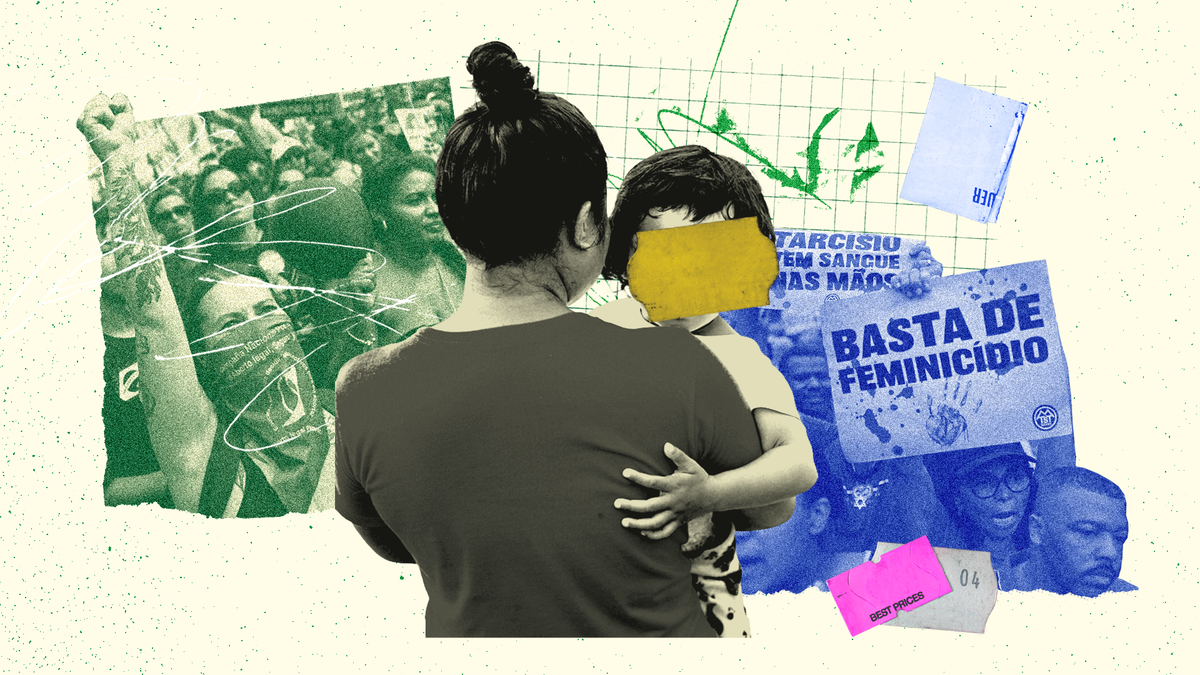
Ester spent two months on this story, speaking to lawyers, shelter workers and survivors most newsrooms never reach. That’s what it costs to trace how child support disputes turn violent in Brazil. Fuller funds it because so few will.
Our latest investigation: Far-right groups use PayPal undetected and undeterred

Investigation: With PayPal focused on profit, far-right groups transact undetected and undeterred
“The far right's use of PayPal is an open secret. While investigating, I was stunned to see the sheer number of far-right groups selling openly racist or hateful items via the payment platform – far more than any other payment provider, despite the provider's own rules prohibiting it. I wondered if PayPal was unable to keep them away... or uninterested.” – Polina Bachlakova, Fuller tech correspondent
The glass half full
Good news stories around the world about women and gender-diverse people.
Women referees are making history at the men’s football World Cup. Tori Penso, Brooke Mayo and Kathryn Nesbitt officiated a game between South Africa and the Czech Republic in Atlanta, with Penso becoming the first American woman to referee a men's World Cup match and the group becoming only the second all-female officiating team to take charge of a match at the tournament.
The HPV vaccine could eliminate cervical cancer deaths in young women. A new study funded by Cancer Research UK found that girls who receive the HPV vaccine at ages 12 or 13 have an almost zero chance of dying from cervical cancer before age 30, adding to growing evidence of the vaccine's life-saving impact.
New York City releases a roadmap to improve childcare. The city's new Marshall Plan for Moms is a task force report that recommends policies to make childcare more affordable and accessible, including reducing barriers to public benefits and advocating for universal childcare in New York state.

The Brazilian lawyer Marina Ganzarolli has dedicated her career to supporting women and LGBTQ+ people who have experienced violence. As the founder of Me Too Brasil and the Feminist Network of Women Jurists, she has spent 15 years advocating for survivors and pushing for legal change. She discusses the rise of misogyny among young men, the hidden role of financial abuse in violent relationships, and why a recent court victory could mark a turning point for survivors of sexual violence in Brazil.
What’s weighing on your mind at the moment?
Marina Ganzarolli: What worries me the most right now is the spread and reach of misogynistic and radical masculinist content, especially through social media, and how easily it reaches boys, future men who are still being shaped. It seems to me that we are dangerously raising a new generation of men who, from all indications, will be more misogynistic and more sexist than the previous generation. Non-sexist education needs to reach boys during their formative years.
Many people associate violence only with physical abuse. How do you see economic dependence and financial control within the broader spectrum of violence against women?
Looking at the cycle of violence, when physical or sexual violence is observed, it is a fact that other forms of violence have already occurred. Violence against women has its roots in the unequal power relationship between men and women. Financial and economic control is an extremely important factor in exercising this control, coercion, persecution and abuse. Financial violence almost always comes together with psychological violence and moral abuse.
Brazil has a relatively robust legal framework to protect women from gender-based violence, including the Maria da Penha Law. Yet many women still struggle to access that protection in practice. When these rights exist on paper, what is missing to make them work effectively?
The Maria da Penha Law is, without a doubt, an excellent regulatory framework for preventing and addressing domestic violence against women. It is a comprehensive law that goes beyond criminal law, covering family and civil matters, protective measures, employability, and access to financial resources. Unfortunately, despite being almost 20 years old, it is still not fully implemented. For example, one protective measure the law allows is temporary financial support to help women break the cycle of violence, but this request is still very rare.
What life lesson has shaped who you are today?
I believe the life lesson that most shaped who I am today was the opportunity, throughout my childhood and adolescence, to take part in volunteer activities with a direct impact on low-income communities. Every December, during my school holidays, I spent a month in the city center asking strangers for money to buy Christmas presents for children with limited resources. Being ignored, overlooked and sometimes treated badly, even while trying to help others, was extremely formative. It taught me humility and shaped the values that continue to guide me today.
Fuller’s mission is to produce groundbreaking reporting that catalyzes positive change for women*. Has there been any positive change for women recently that you’ve found hopeful or inspiring?
Two weeks ago, Brazil's Supreme Federal Court decided to overturn the criminal ruling that led to the acquittal of André Aranha, accused of raping Mariana Ferrer. Her case gained national attention because of the humiliation, revictimization and retraumatization she faced within the justice system itself. This led to the Mariana Ferrer Law, in 2021, which prohibits judges, prosecutors and the criminal justice system from humiliating survivors of sexual violence during legal proceedings. This is a victory not only for Mariana Ferrer, but for all survivors of sexual violence.
This interview has been edited for length and clarity.
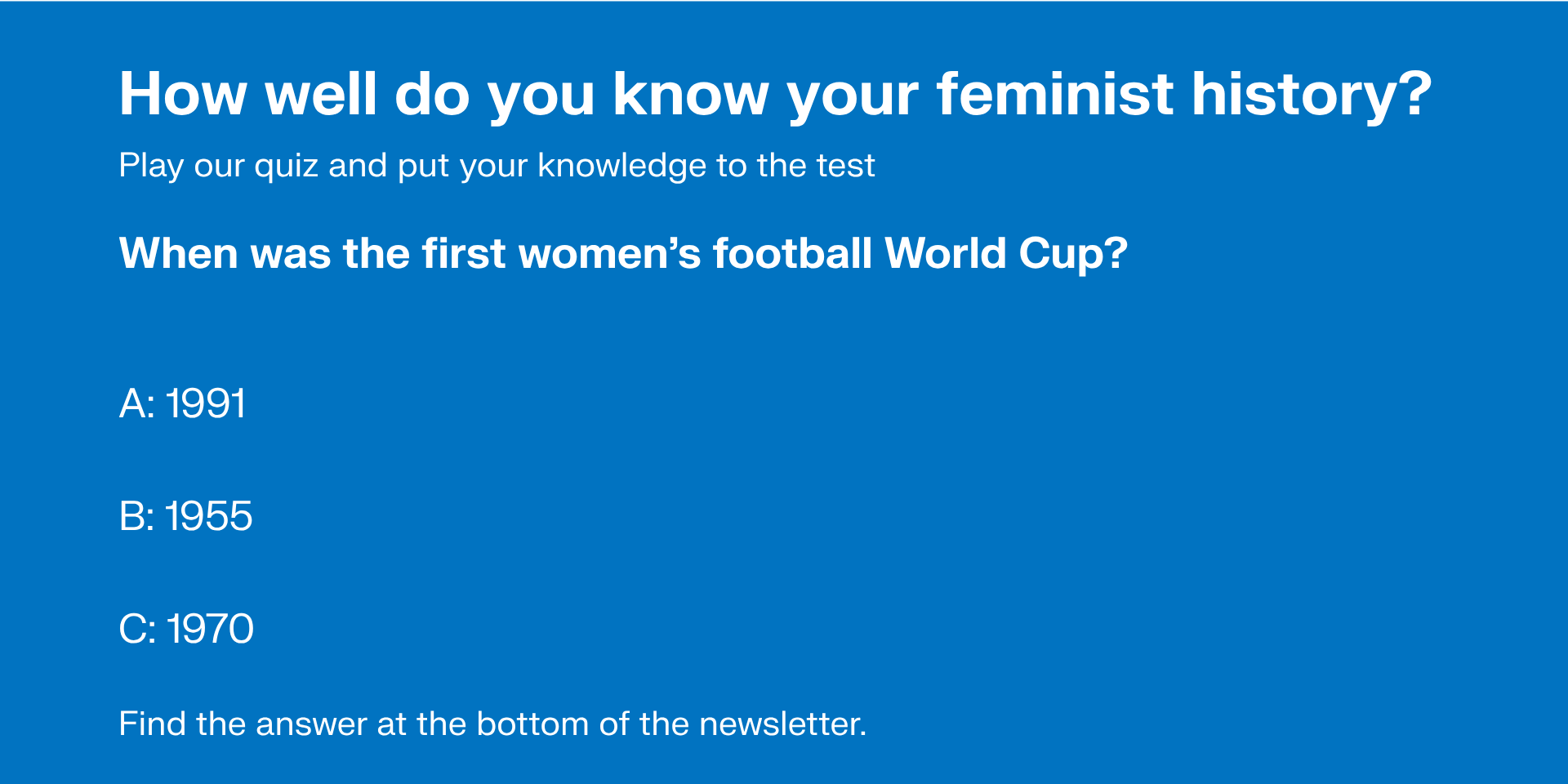
Quiz answer
The answer to our feminist history quiz is: C, 1970. The first unofficial women's football World Cup took place in Italy in 1970. The winners of the tournament were Denmark, who beat Italy 2-0 in the final. The first-ever official Fifa Women’s World Cup took place in China in 1991.