Interviewer: Eliza Anyangwe
Guest: Ece Temelkuran
Producers: Imriel Morgan and David Roberts
Collage: Ethan Caliva
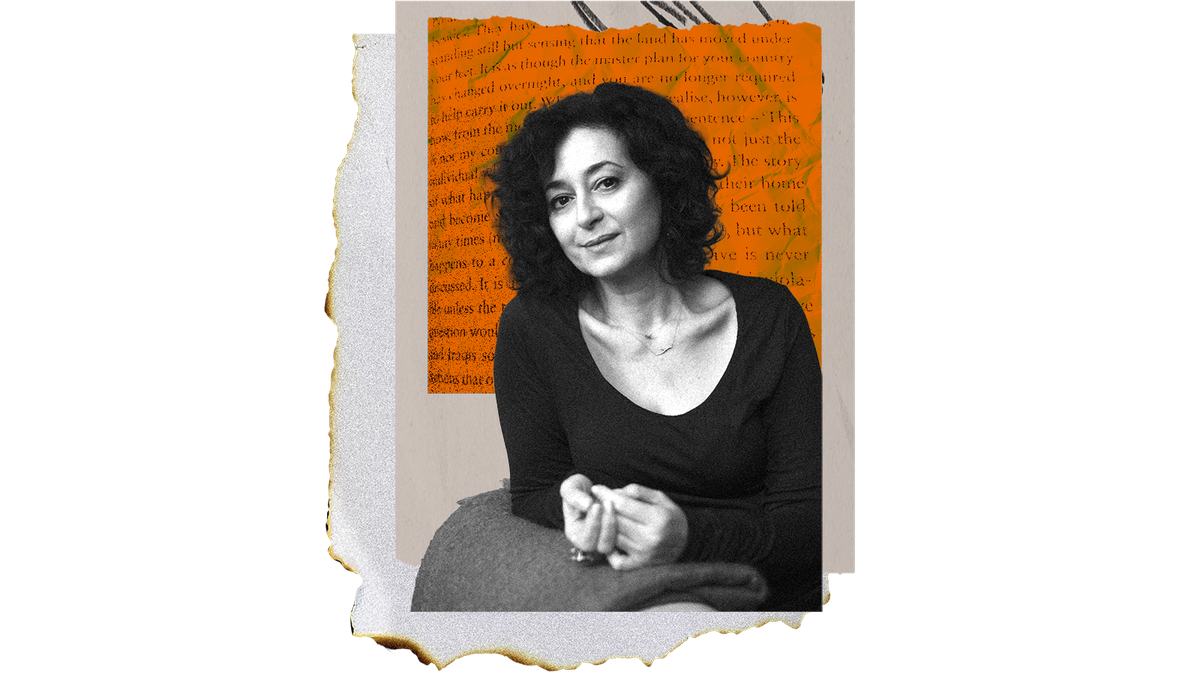
Acclaimed Turkish journalist and author Ece Temelkuran talks to Fuller’s editor-in-chief Eliza Anyangwe about her new book, Nation of Strangers, the protests in Minneapolis, and why naming fascism matters
Transcript
Ece Temelkuran
Recently I noticed that the right answer to the question of “Why you use the word fascism?” is, “Why don't you?”
Eliza Anyangwe
I'm Eliza Anyangwe, Editor-in-chief of Fuller, and this is ‘The Big Idea’.
Eliza Anyangwe
Today I speak to Ece Temelkuran, Turkish political commentator, acclaimed author of ‘How to Lose a Country’ and her upcoming book ‘Nation of Strangers’.
Temelkuran, welcome to this Fuller conversation. You are the first in our new series called ‘The Big Idea’. Where I sit down with thinkers and doers who have a big idea that will help reshape, rethink how we work together, and society really bringing women and gender diverse people much more into the center of the narrative. And I'm delighted to be in conversation with you today, really, as you start your tour for your latest book, ‘Nation of Strangers’. So congratulations and welcome to this conversation.
Ece Temelkuran
Thank you. Eliza, it's lovely to be with you today.
Eliza Anyangwe
So, I have so many things that I want us to try and tie together. But before we get there, let's start with the title of the series, ‘The Big Idea’. What is your big idea?
Ece Temelkuran
My big idea is that we cannot fix democracy or the rule of law with quick fixes. We need a moral transformation. And if you will, a moral revolution to change the world. To stop this dark current of history.
Eliza Anyangwe
Okay, so there are many things in there that I'd like to unpick. Fuller has moved to an editions model where we publish our journalism, anchored around a specific topic, and look at it from different perspectives. Of course, always bringing gender into the agenda. And our first edition is ‘Revolutions’. You say we need a moral revolution, what do you mean by “moral” and by “revolution”?
Ece Temelkuran
You know, for the last decade, very dramatically, but actually for the last two decades, democracy and rule of law has been in decline. In a crisis, actually. That's why I wrote ‘How to Lose a Country’: Seven Steps from Democracy to Fascism. This dark current of history, as I call it, is operating in exactly the same way in every country. And the idea was to warn the Western societies so that they don't do the mistakes that we have done in Turkey.
I thought, why did we lose faith in ourselves, in our political agency? And I realized that for the last five or six decades, this loss of faith has been imposed on us, this loss of faith in politics. And in each other, in togetherness. That's why I wrote ‘Together’. In that book I explained why we need a moral transformation — because the loss of faith actually has a moral reason, rather than a political reason. Or it goes deep down to morality, so to speak, because the fundamental definition of human beings in the system we're living in, call it neoliberalism or capitalism, is that we are self-centered, selfish bastards, and our survival depends on stepping on each other.
I think that moral creed, so to speak, has been imposed on humanity. So much so that we lost our faith in each other, in ourselves, in our political agency, and in politics in general. That's why I say we need a moral transformation. And to be honest, this moral transformation, this moral revolution, is happening in several places on the streets. It happened in the Tahrir uprising. It happened in the Gezi uprising. It happened in several uprisings in Europe. And previously, it happened in Minneapolis. What we see there is actually the opposite of the fundamental definition of human being. People there without nothing are protecting each other. They are believing in each other. They are believing in themselves. So I think what I suggest to the world, that moral revolution is happening on a smaller scale, micro-scale, in several places. Unfortunately, it is not permanent yet. It is not admitted, acknowledged yet.
Eliza Anyangwe
If I may say this, I think there's so much of where you're coming from, both in the naming, which was now ten years ago, right in 2016, where you sort of went around the world, I think you said twice, you know, beating the drum of the approaching fascism. It struck me that it takes a feminist to both name the problem and to name the solution. Here's why I think it took a feminist and and maybe you might not use that label to name the problem.
Ece Temelkuran
Of course I do, we should all use that label.
Eliza Anyangwe
I reckon, I think so too. I think so too. It took a feminist because, of course, fascism and authoritarianism comes first for the most marginalized and women because of patriarchy, and let alone gender diverse people are most often in the margins. And so you need to be looking into those margins to notice, you know, how civil liberties and rights are crowded out from the outside in and to then start to name it, but also your solution, which is about moral revolution, which is about care, compassion, faith and love.
These are terms, for example, that bell hooks and other feminists have used. And still we're seeing in the mainstream as sort of “woowoo” right? You know, if you're talking about political issues, the solution needs to be something harder or fiercer. But indeed, it's a sort of love your neighbour attitude that gets you out onto the street in support of people you don't know. It's a sort of collective care, which itself is feminist. Does this feel like a useful way to understand how you have both arrived at naming the problem and your solution of moral revolution?
Ece Temelkuran
Absolutely. I mean, like I've been saying this since 2016, we are the canary in the mine. All marginalized people are. But women, you know, we have been marginalized for so many thousands of years that we can feel the difference in the air, like, you know, the change of air. So we know when we have to survive. We are built in that way. We were forced to build in that way. The thing is, especially in ‘Together’, that idea is very present. And I say that out loud, so to speak. The future is female, but when I say future is female, I don't mean the future will be, you know, where women will be powerful. No. Female is a wider concept. Female, is the exact opposite of what neoliberalism is. Female is the exact opposite of what fascism is. And speaking of, shying away from the word, I wish so much time had not been lost with Western exceptionalism.
Eliza Anyangwe
What do you mean by this?
Ece Temelkuran
Because when I said fascism with few other people in the global intelligentsia, people were smirking at us like ten years ago. However, they were indulging themselves in the comforts and the luxury of being protected by institutions, trusting them, so much so that they didn't see or they did not want to see what's coming towards them — that there is a global pattern to this. And I had to, on many stages, answer to white established men why I use the word fascism. They were scrutinizing my reasons. I can go on and on about this ideologically, politically, historically, why I call it fascism. But recently I noticed that the right answer to the question of “Why you use the word fascism?” is, “Why don't you?”
Because I notice that the reason they're not using the word fascism is not academic. Actually, it is more emotional, if I may say so, because once you call it fascism, you have to do something about it. If you call it right-wing populism, authoritarianism, it sounds like a passing fancy, and then it's manageable. But once you call it fascism, then you have to act up, so to speak, or up your game in a way. Coming back to the future being female, it doesn't only include women, it includes the female in the men as well, which is caring, which is compassion, which is all these small words — “small” underlined. Eliza, there is something funny about these words. And I mentioned this in my new book, ‘Nation of Strangers’. They are so humble that once you try to, theoretize them, once you try to put them in the social contract, once you try to intellectualize them, they almost shrink and they, you know, they run away. They're so elusive.
But they're also very inherent in us, in human beings. So as part of the moral revolution, maybe we should say we have to protect the female in us, in humanity and in the world. So, this idea of we are exhausted of compassion has been imposed on us lately. No, we are not exhausted of compassion. We are exhausted of not being able to do anything about the things we care about.
Eliza Anyangwe
Yeah. It's really interesting because and actually, to make it concrete for anyone who might listen to this conversation and think, oh, this is all very nice and theoretical. When you see the response of the most powerful people to some of these ideas — I think you might know this quote, from one of the world's most powerful or richest men, if not the richest man, Elon Musk, when he said “The fundamental weakness of Western civilization is empathy.”
What is it that Elon Musk recognizes in empathy, that means it is something so dreadful that must be discarded.
Ece Temelkuran
This is exactly why I'm talking about moral transformation. Elon Musk is not a bad man. Elon Musk is not a strange man or outrageous man. He is just the one of the, by the way, one of the many, examples of how neoliberal morality is embodied. He's the embodiment of neoliberalism. So he's actually a successful good man according to the theory that we’re living in.
So I don't understand why people are mocking him. We are all living in that morality. He's just taking it to another level because he can do that, because he's powerful enough to do that. Doing it can be ruthless and reckless and so on. And empathy, the funny part of that empathies story, I think it is very limiting, that word.
Eliza Anyangwe
Elon Musk is throwing his toys out of the pram for an idea that's not even the most sort of radical idea is what you're suggesting. There's something else that when I was listening to some of the talks that you've given, you've even said how, equality is, you know, not necessarily the sort of end goal or the biggest concept.
You talk instead about dignity. Can you say more about this? Like, why does dignity trump equality? Because of course, we are a newsroom that is looking at the question of gender inequality or the lack thereof. So, you know, move us from equality to dignity. What does dignity hold that equality doesn't?
Ece Temelkuran
Yeah. Equality is a quantitative perception. It comes from a quantitative perception of the world and humanity, where dignity admits and signals that we are more than this quantitative equality. And I use the word “dignity” a lot because, in the last two decades, all these fascist movements depended very heavily on the word “pride”. It happened everywhere. All these political movements came to power or crept to power using and weaponizing the word pride. Your pride is broken, and I'm going to mend that pride. So pride is an interesting word because in order to mend it, you have to break another person's pride in most cases.
So dignity, on the other hand, is very much related to the oneness of humanity. That is why when we see a person whose dignity is under attack, even though we don't know the person, even if it's a video that we are sliding, we feel that inner pain, and that inner pain makes us human. And that inner pain, or the value that the pain comes from, should be the center of the discussion when we are talking about politics, when we're talking about morality.
Eliza Anyangwe
How would you like us to move the conversation forward? I was going to ask if you felt vindicated, but I imagine that there is no vindication in the coming true, a coming to pass of what you saw. But perhaps because you have been seeing it for the last decade, what are the steps that you would like to see us take now?
We should surely be moving past acknowledging because it's here. What is that next step? And is that in exploring this idea of home or humanity and dignity as your newest book, in a very personal way, tries to get us to engage with how we move to a sort of different way of acting and reacting?
Ece Temelkuran
The book is written in letter format, so it's one-to-one. Every letter begins with “Dear Stranger” and I'll tell you why I say “Stranger” and so on. But the language itself is a new political, moral language, I think, because it comes from humility and the full assessment of reality, acknowledging the reality of the world, which is we are all living in survival mode at the moment. You know, or you don't know, almost ten years ago, I left my country. So I became homeless in a way, and when I was writing ‘How to Lose a Country’ and ‘Together’, I didn't think about myself. But I thought about the world, and I came up with political ideas, political solutions.
And after seven years, I finally noticed that my homelessness actually is the homelessness of the world. I'm not alone. We are so many. We are becoming homeless on so many levels. People like me, you know, refugees, exiles, immigrants, asylum seekers, we are millions and millions of people. But not only that, you can sit in your living room and suddenly something happens in your country, such as Trump, and then suddenly you become homeless.
You're in your home, but you are unhomed and suddenly you don't recognize your country. And this happened in so many countries already. You are becoming morally homeless as well. You know, you're seeing Gaza, you're seeing Sudan. You cannot do anything. And you see that the world is not doing anything. So you are morally homeless. You're a moral refugee in this world.
So you're a stranger. You're becoming politically homeless because you're constantly voting for those parties while, you know, holding your nose. So there is no political home for your outrage about what's happening in the world. And we are all becoming spiritually homeless because the language of our spiritual home is now being stolen away from us, thanks to AI, because there is now this entity speaking human language, although it's not human.
Why I talk about this home idea so much, or why I try to say that everybody is homeless because I want people to acknowledge that we are in a survival mode. It's not only democracy we're losing. It's not only the rule of law we are losing, we're losing everything. We're losing our ultimate home, the planet.
Eliza Anyangwe
You know, we've lived very different lives. And yet there is something that I found both really compelling and personal. I think we talked a little bit about this in our pre-call. As someone who grew up, you know, my family's from Cameroon. I carried a Cameroonian passport until 2018. But I moved all across sub-Saharan Africa, mostly. And by the time I was, I think 18, I’d lived in 10 countries on three continents. And I felt like a stranger everywhere. And also then like a stranger in Cameroon. And this has come to me to be something of an opportunity, as opposed to, you know, because when I think of sort of like the in-group and the out-group, like those who belong and those who are other, there's something really destabilizing and terrible about this, right? On a good day, I feel like I belong everywhere, and on a bad day, I belong nowhere.
But when I think of all of us as strangers, then there's a kind of curiosity that sparks, that I can set myself on the path to know other people. And they can also then want to know me. And if we're all strangers, one from the other, it is incumbent on all of us to kind of become more familiar. Whereas belonging, that says because you were born in a place or because you are a certain race or because you're a certain religion that makes you lazy, you don't have to do the work because you're supposedly already known to each other. And then there are those who are threatening that by their otherness. So when I hear you talk about strangers, I think the word perhaps elicits in us a sense of something negative.
But I feel it. I experience it more as an opportunity that if we saw each other this way, then it becomes possible to relate more equitably, if that is possible. Because there is something about each of us that is still to be discovered, and known, and so I find it hopeful, actually, to understand each other as strangers.
Ece Temelkuran
Speaking of curiosity, that's such an interesting word, because I think curiosity is a pure form of it without any judgment. It is a form of love. It is the most beautiful form of love, curiosity. That means that you're giving your attention because our political language or urge to be correct in political language, stopped us from being curious. It's as if asking questions or being curious became sort of offensive. I think we should reverse that.
But the main idea of calling people strangers is to tell them, yes, it is okay. It's a positive thing because my thinking was that we are all strangers, especially foreigners, immigrants and so on. Who lost or already lost their homes. So we are not coming to you as a burden. You're coming with a knowledge of survival. Because we are the ones who know how to survive with dignity. And that's a very, very difficult question when you look deep down into it. But we managed that. We rebuilt our homes, we kept our humanity intact and we still love people.
So your future, dear humanity, will depend on this knowledge that we already carry in our bodies, in our minds. So let us tell you that this is how you're going to survive. This is what's going to happen to you. This is how painful it is. But still you can do it. So you're absolutely right. Nation of strangers, surprisingly, is a very, very — positive is not a good word — but yeah I think there is joy in it. I should put it that way — there is joy, the joy of dignity and joy of surviving together.
Eliza Anyangwe
I would imagine that writing a book is almost a spiritual practice. You go on a bit of a journey in sort of articulating this idea and writing it out. What transformation, and I think through practice, then comes change. What change happened for you through the practice of writing this book? Where are you now that, you know, you weren't when you started? How is it showing up in your own life?
Ece Temelkuran
Great question. This was the hardest book. Not only because the concept of home is so vast, but also, I'm embarrassed to talk about myself. I find it morally and politically problematic to talk about the self. So I was trying to figure out how to speak about the self, without being, without falling into the traps of vanity, so to speak. Because when you're a stranger, when you're an immigrant, you're given two roles or two options, either the victim or the survivor. And I didn't want to be either.
What is interesting, and I didn't know this when I started writing the book, I came back to the idea of beauty. Because when you're a survivor, beauty becomes a luxury aesthetic. Beauty becomes a luxury. You don't buy things for your new apartment because you know that it's going to go — if you're not going to live there. So bit by bit, you kind of distance yourself from beauty, in a more profound sense. So at the end of the book, I remembered beauty, and I remembered beauty not only in an aesthetic way, but also a moral and political way because I realized that what will help us to stay humane while surviving is our urge to create beauty and to have beauty in our lives. And when I say beauty, I mean political beauty, moral beauty, aesthetic beauty, spiritual beauty, emotional beauty. Because only through that very fragile word “beauty”, because all that is beautiful is always fragile, can actually give us the power to stop the dark current of history and to stop ourselves falling into the dark holes of human existence.
Eliza Anyangwe
You talk about ideas that are vast and grand, and I keep thinking how to bring this into my own experience and into our newsroom. You know, we talk a lot in journalism — particularly impactful journalism, investigative journalism — focuses on shining a light on what is ugly and what is bad. And we've been grappling with the responsibility for the emotion that creates in people. And it's often not one that elicits a desire to survive or to preserve things, but rather to turn away from them. You know, and accept our sort of like, the doom of our fate. And so in grappling with that and thinking about how we can elicit different emotions, we have been thinking about beauty. How do we make our journalism something that people want to spend time with?
So in our ‘Revolutions’ edition, for example, Sudanese-American musician Alsarah is curating a playlist of revolutionary music so that you can read the, you know, the serious stories, but you can also sit with song. And you know, this in some ways, let me be honest, feels like a far departure from sort of how we are trained as journalists. But it feels, in this moment, so important to help people, navigate this really difficult time by helping them to see what is still human in us. And because that perhaps is going to be more energizing or activating than the opposite. Have you found that so far?
Ece Temelkuran
Well, I mean, it's a big, big topic in ‘Together’. When you talk about revolutions, past revolutions or past uprisings, people tend to think that they are defeated and that's it. Our memory is prone to not remember the things before the defeat. Yes, they might have been defeated, but there was something else there, joy of dignity. This is why I wrote that chapter in ‘Together’. There was joy of dignity, which we have seen in Minneapolis recently.
Eliza Anyangwe
Yup, just last week.
Ece Temelkuran
And when I speak about rest and rather abstract ideas, I actually come from very real life. The beauty of resistance, the beauty of protecting your dignity, creates a joy that is immense and infinite, to be honest. That's why, and I am absolutely sure if we ask the people in Minneapolis, even though there is so much violence, they will tell you they were the best days of their life. This part of history is always removed because we are so interested in winners, which is another neoliberal morality I think. We are so interested in winners that when something is defeated, we don't have to look into them. The other day I saw a video. A Viking in a bathtub is, you know, going down the street, going down the hill and ICE guys, you know, running after him. That is beautiful. You know why it's beautiful. And you know what beauty is in that context? Because it refreshes our faith in humanity.
And we are seeing in real life in Iran, in Turkey, in several other places, people are doing these random things, maybe helping other people during that time of trouble or resisting in such a way that makes the courage contagious. They are creating these moments in history that refreshes our faith. That is why we call them beautiful. That's why, in fact, and this might speak to you as a journalist, did you notice that we are not crying anymore when we see kids dying in Gaza? We don't cry anymore when somebody hits somebody. But we cry when we see something in that noise and in that mist — something beautiful. You know what it is? Because we are exhausted. We are emotionally and morally exhausted. So when there's something beautiful that softens up, survival automaton cracks up and it remembers that it has a heart so beautiful. Creating beauty is not only about drawing flowers or singing a song, but also, or more importantly, to create moments in history to refresh the faith in humanity. This is what we need, I think.
Eliza AnyangweCan you give us any examples from, and you already are doing so, but maybe Turkey or elsewhere of how both to resist but to create beauty? What might we step away from here to do that preserves that humanity, even as we're going through the indignities of this moment?
Ece Temelkuran
This is a great question. I was actually thinking about this yesterday, because, since two decades now, the resistance has become so carnivalesque. It is like, yeah, it's like a carnival. And sometimes — and Americans do not know this yet, they will learn — sometimes you become, you fall in love with your own carnival. And you forget that this is a political act. I see many people, Americans, being so proud that this movement is leaderless. This movement is, you know, random, it's spontaneous. It's individuals coming. Great. But don't get lost in that, you know, in that, illusion. It's a political movement, and it needs structure. It needs organization.
And so the one thing I think many people from Gezi uprising or Tahrir uprising would tell now that, yeah, we should have had, you know, proper organizing among each other and also carnival. It's amazing of course, it's incredible, this incredible joy of humanity. But also it's exhausting. And the other side — do not get exhausted. We get exhausted. So I would tell people, sleep, sleep. I know, I know, you're too excited to sleep, but you have to sleep. So like very practical things. But I think it is important.
Eliza Anyangwe
As you speak, I'm reminded of Vincent Bevins’s book where he sort of looks at the last ten years of protest, the protest decade, and realized that the energy of mass movements in Brazil or into Tahrir Square, actually the people who capitalized on that were planning in the shadows, right?
They weren't the sort of like leaderless mass, and the enthusiasm of that didn't end up then resulting in what people wanted it to, because it then wasn't able to sort of coalesce around a structure. And we've been sort of thinking about this with ‘Revolutions’. Why is it so often that women are so foundational in the forefront of revolutionary action? We saw this in Myanmar, in the pro-democracy movement. We saw this in Sudan, that iconic picture of a young woman leading other women in chants. And yet when protest becomes policy, why do their needs fade from view? I'm assuming there's, from what you're saying, the need to both think of structure while enjoying the sort of coming together around an issue, but also the need to kind of, not give yourself entirely over to the carnival to rest in.
Ece Temelkuran
Oh, you can, you should. I mean that feeling is like nothing else. But speaking of women, all big revolutions, Russian revolution, French revolution, they all were started by women. It's like if anybody who doesn't know this, they should go back and brush up their history, you know, knowledge. It is only natural that it happens because, when a system collapses, women pay the price more than men do. They have children they have to feed. And also they are more under attack than men are and so on. The second part of this question is important. You know, why then we are not in the forefront when a new system is established? And that's why I wrote in ‘Together’ that the “future is female.” Because this time around there's something different.
This is the first time in history we have this much education. We have this much political experience. We have this much economic power as women. And we have the experience of our failures. So this is why fascism is, more than anything else, against the female, because they are, this time, they are strong enough to do the job to take it to the next level. Women. And more than anything else, fascism is against women and all that is female. So, I think this time, this time around will be different. And I keep seeing it everywhere. That is why there's a global war against women. Of course, you know, the front line might be Iran, Afghanistan or those really, really oppressive countries. But that global war is very present in Western countries right now as well.
So, I think men also should know if you let women fall, you’re next. Because they are not used to this idea. They know that when the new status quo is built, they will have a place there. So they have the luxury to negotiate with new establishments, with the new system. But this time they should know the female in them, which makes them human, will be slaughtered as well if they let the women fall.
Eliza Anyangwe
I think that is the note to end on. I think that is the place to end because it includes a warning, and that warning is to us to hold on to that thing. As you said at the start of the conversation, the ideas that are bigger than pride, which is about care and dignity, but also, I don't want to make it sound trite with the word “hope”, but there's something radically hopeful about what you're saying. That we are learning the lessons of the past, and maybe this time around it will be different. And that helps us to both understand the moment, you know, our next edition is on the far right and one of the central questions in it is, “Why has feminism become the boogeyman of the far right?” And you've already answered that question, for us. But it helps us to kind of remain really sharp as we think about what is happening across the world. And it is, as you said, Iran or Afghanistan may have a particular bent or view there, but really, this is a threat to us all.
Ece Temelkuran I cannot thank you enough for the work that you do in the world. I hope you yourself are able to rest and do not completely exhaust yourself as you end up going around the world again on this book tour. We wish you every success with it.
Ece Temelkuran
Thank you Eliza. It was a lovely, lovely conversation.
Eliza Anyangwe
Thank you.
Interviewer: Eliza Anyangwe
Guest: Ece Temelkuran
Producers: Imriel Morgan and David Roberts
Collage: Ethan Caliva