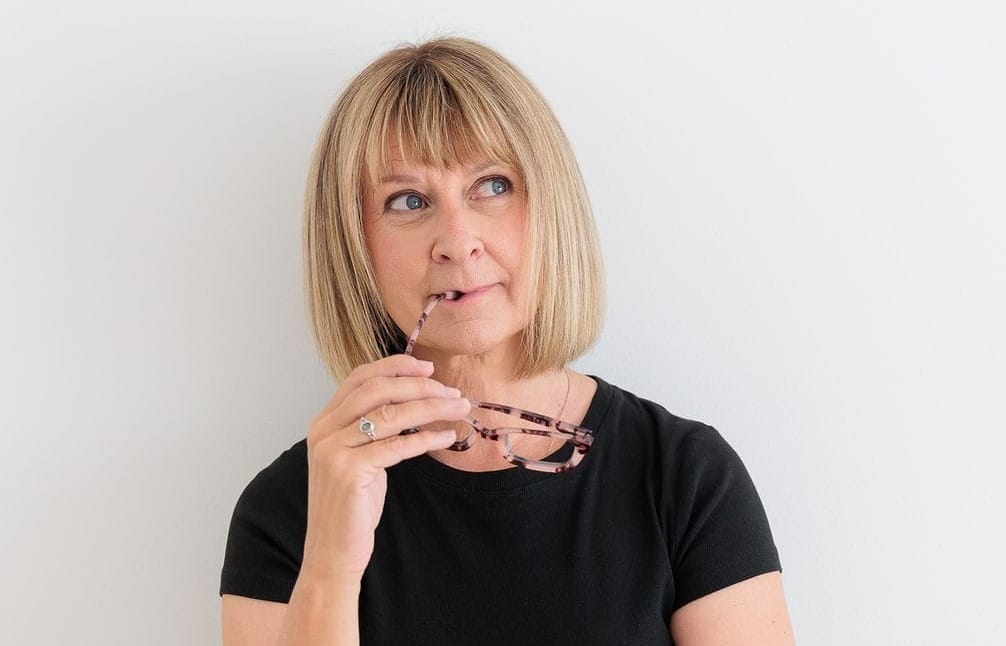
On a good day, Ingrid Smith spends half an hour reading the comments underneath her Instagram posts, scanning for hate, which she promptly deletes.
The retired teacher, living in Toronto, Canada, runs a coaching business that supports many US parents of gender-diverse children, drawing on her experience of being a mother to an adult transgender daughter. She likes to post reassuring selfie videos – angular, blonde bob bouncing as she talks through the importance of pronouns or reminds parents that their messy feelings are okay.
But on a bad day – if one of her posts goes viral “in that world”, as she puts it – that same task will take her almost an hour. Twice, she had to close down her comment section entirely. “If it feels overwhelming, then I know I’m not going to be able to keep it up,” she explains. “I start feeling sick.”
“That world” refers to the transphobic segment of the US internet. According to a report by the Institute for Strategic Dialogue, a research organization analyzing extremism, disinformation and online threats, anti-trans hate speech online is on the rise in the US and goes hand-in-hand with “political developments”, including Donald Trump’s re-election.
In December 2024, just before Trump took office for the second time in January, he vowed to “stop the transgender lunacy” on day one of his presidency. Although attempts to take away trans people’s rights and freedoms have been steadily intensifying over the past six years, 2025 marked a turning point.
More than 1,000 anti-trans bills were proposed last year, from those that bar them from public restrooms that align with their gender identity to legislation that makes providing gender-affirming care (interventions designed to support and validate an individual’s gender identity when it conflicts with their sex assigned at birth) punishable by life in prison.
Of that figure, 126 laws were passed last year, the largest amount ever.
It's within this context that people are leaving derogatory comments about Ingrid Smith on her Instagram. As the mother of an adult trans child, she is under particular scrutiny from influencers across different social media platforms. This backlash reflects a wider trend of mothers being blamed for their trans children’s gender identity.
“It's always the mother's fault, right?” sarcastically remarks misinformation researcher Ari Drennen, a former LGBTQ+ program director at Media Matters, a nonprofit that counters misinformation.
‘It’s mothers who trans the child’
In an analysis of 1,250 social media posts, containing the words “trans” and “mother” and shared across 19 platforms between 6 August 2025 and 4 February 2026, Fuller found that almost two-thirds (735) expressed negative sentiment about trans people. And of that number, nearly half (356) were specifically concerned with their mothers.
A search for posts on platforms such as X, Instagram and TikTok that mentioned “trans” and “father” yielded 14% fewer results than posts about mothers. Crucially, when fathers were mentioned in the dataset, they were often portrayed sympathetically: as victims of manipulative wives. One post stated: “It's always the mothers who trans the child, and the fathers who fight to stop them.”
A post about Elon Musk on X, who, according to media reports, planned to file for custody of his 13th child because he worried its mother, Ashley St. Clair, would try to “transition a one-year-old boy”, stated: “He's right to be concerned! It's bad enough one teenager of his fell for this dangerous, radical ideology, but for a mother to possibly push this onto a toddler & an infant? Disgusting!”
There is no indication that St. Clair was advocating for transition, but Musk does have a 21-year-old trans daughter with his ex-wife, Vivian, whose gender identity he refuses to recognize. The tech billionaire has said he believes Vivian fell victim to a “woke mind virus”.
Overwhelmingly, though, the dominant characterization of mothers in the dataset is as victims.
This framing showed up 153 times. Multiple posts spread disinformation and presented mothers as being at risk of being “strangled” or “raped” by their trans children, reinforcing the myth that trans people are more likely to be sexual predators. Users also imply that mothers are victims of a society trying to harm their children – women who’ve had their kids “swept up in the trans cult”.
Who's the real victim?
But what motivates social media users to portray these mothers as victims? Researchers that Fuller spoke to suggest that it is both a tool to communicate that trans people’s very existence is harmful, and a recruitment tactic to get more people to subscribe to their ideology. The subtext is that if trans people would hurt their own mothers, they must be inherently bad.
“Conservatives don’t like women. But they use them strategically all the time,” says Quinnehtukqut McLamore, an assistant professor at the University of Missouri whose work focuses on transphobic disinformation online.
According to McLamore, in the 80s and 90s, sexologists Richard Green and Kenneth Zucker blamed overly close or emotionally “overinvolved” mothers for their children's sexualities and gender identities. Fuller’s data analysis shows that the prejudice that emerged from this contested science is still alive and well.
Fuller found that 38% of the posts about trans people’s mothers position them as enablers of the trans “delusion” and 19% as “groomers” (a slang term for paedophiles). It rarely mattered how much or little was known about the mother: the underlying message was, as one post put it, that “the whole trans thing was her idea” and that she “mutilated” her child. That word and its variations (mutilator, mutilated) appeared 35 times across 21 posts in the dataset and echo rhetoric coming out of the White House.
In June 2025, the FBI, led by staunch Trump supporter Kash Patel, said that it would investigate gender-affirming care providers for “mutilating” children. And in March 2026, President Trump wrote “NO TRANSGENDER MUTILATION SURGERY FOR CHILDREN” in a post on Truth Social, which he’s since deleted.
“When the federal government takes your position, that's extremely validating and emboldening for these people. I think that's why we've seen an escalation of anti-trans parents,” says Andrea James, an activist who has spent 30 years building an online encyclopedia for trans people and their allies called the Transgender Map. Fuller has not been able to independently verify an overall increase in anti-trans parents.
The anti-trans moms of trans kids
Some of the furthest-reaching posts – and recurring anti-trans voices in the dataset – were by the mothers of trans children who refuse to support or recognize them.
These women amass social media followings by almost exclusively arguing against the rights and freedoms of trans people, and, in some instances, by attacking other mothers.
Gabrielle Clark, an anti-trans mom reportedly based in Las Vegas with over 50K followers on X, wrote last October: “When I’m advising parents on how to pull their children out of the trans cult, I have to advise them to resist the urge to try to reason with their children.”
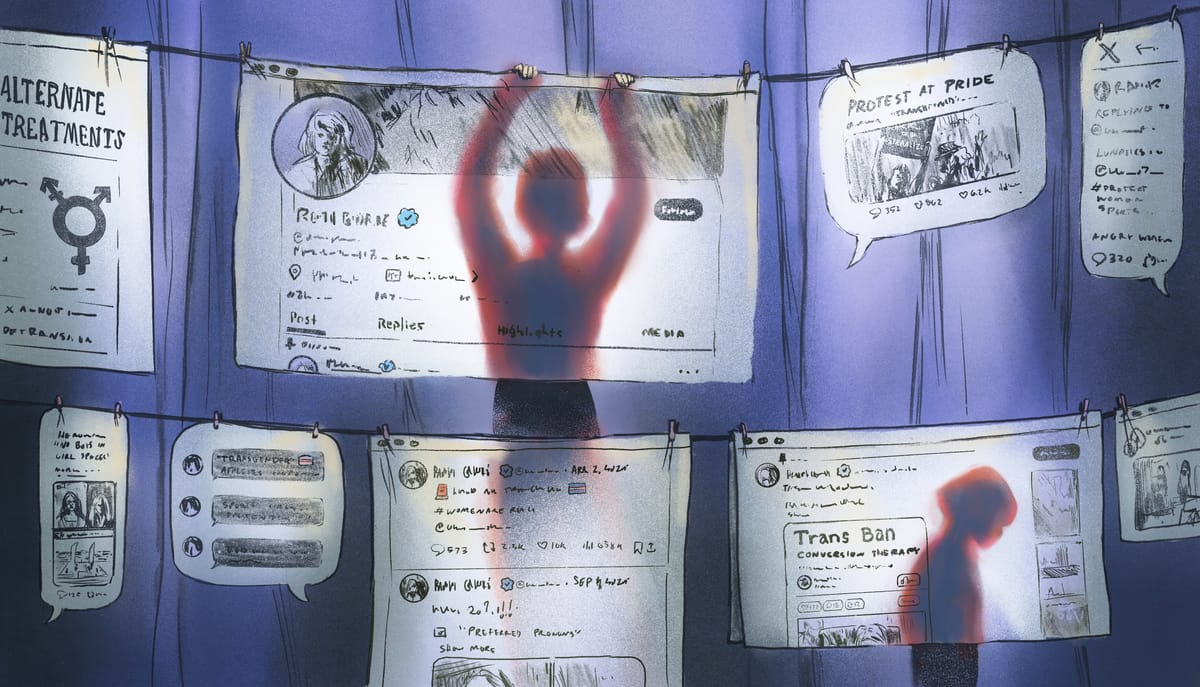
Beth Bourne, based in Davis, California, has a similar number of followers on X to Clark. One of her posts – a video in which she confronts another mother on the street and accuses her of “sterilizing that child” – has been seen over 24,000 times.
Bourne has targeted trans people online and also builds her notoriety offline. Recently, she disrupted a school board meeting to protest trans people’s inclusion in bathrooms that align with their gender identity by stripping down to a bikini.
Also in the dataset is a post by Erin Friday, who sits on the board of Genspect, designated as an anti-LGBTQ+ hate group by the Southern Poverty Law Centre. Genspect itself posted about the mothers of trans children seven times over the six month period analyzed.
Friday has more than 22,000 followers on X; she accuses gender-affirming schoolteachers of being “groomer teachers” and positions herself as “a mother who saved her daughter after she claimed to be trans” on her own social channels as well as in her appearances on right-wing media.
Fuller contacted Clark, Bourne, Friday and Genspect for comment but received no response.
The data also shows four posts from an organization called Partners for Ethical Care. One of its co-founders, Jeannette Cooper, based in Chicago, is the mother of a trans child who, in 2019, lost a custody battle with her ex-husband over their 12-year-old child, who wanted to transition.
“The concept of gender is a prison,” she says in an interview with Fuller. “I'm all for the liberation of us from the concept of gender, the abolition of gender, those expectations based upon our sex – women and men.”
She calls trans people “mentally unstable” and equates providing a child with gender-affirming care to shooting your spouse. Though Cooper insists that she’s “not really on social media”, she manages a Facebook group for “concerned parents” of gender-diverse kids that has over 4,000 members. Despite her own position, she says that the group welcomes all viewpoints, even ones she doesn’t agree with.
Cooper says she still has no contact with her child. “Sitting there like an Amish family with an empty chair for the person who is shunned is a little bit unhealthy in my view,” she says of their ongoing estrangement. “Constantly reminding yourself of what you don't have is the opposite of gratitude.”
In 2022, she described parents who provide gender-affirming care to their kids as leading them “to the gas chamber”. When asked to comment on that statement via email, Cooper responded with details from a deposition, in which she said she views the comparison as analogous to “medical interventions and medical professionals who are intervening physically and psychologically in relation to the concept of gender”.
‘A bad woman’
Debi Jackson, an LGBTQ+ advocate and mother to a trans child who shot to fame after her child was featured on the cover of National Geographic, has been called a “paedophile” and a “munchie mom” by parents online – the latter of which is a derogatory term for mothers they believe have a mental illness called munchausen by proxy, where caregivers create the appearance of a health condition, often in their children.
“It's always, ‘That mom is so crazy. She's clearly not even with a man anymore; he would have cut her loose’,” Jackson explains. “And then if they do see that there's a dad in the picture, it’s, ‘He’s not putting his foot down and that woman is running all over him.’ He is somewhat given a pass on the reason the kid would be trans.”
Explaining why mothers of trans children are more often the subject of hateful disinformation and abuse, McLamore, the researcher at the University of Missouri, says: “I think that that does speak to a lot of institutional misogyny and pressures that are placed on women to have kids come out ‘right’. In a conservative society, if your primary obligation is to produce children and your children come out gay or trans or mentally ill, you have produced bad product. That means you are a bad woman.”
Drowning out the hate
McLamore says that until last year, social media was the “pivotal ingredient” in the spread of transphobia. “But it has escaped containment, for want of a better word,” she says.
In July 2025, the Trump administration hosted a workshop called The Dangers of Gender-Affirming Care for Minors, inviting a range of influential anti-trans medical professionals, litigators, lobbyists and influencers to speak, including Beth Bourne and Erin Friday.
After years of being harassed online by transphobes, Jackson, whose child is now a teenager, has developed a thick skin. “If people say something really ridiculous, I'll reply to them so it can stay up as an educational moment,” she says. She worries that if she doesn’t speak up, insecure parents could be influenced. “I worry about the impact on the mental health of trans kids who grow up with a parent who’s afraid to proudly support them,” she adds.
Smith, on the other hand, worries about what the comments reveal about what people think outside of social media, where they could act on their beliefs and physically hurt trans people. Nevertheless, she persists.
“What typically happens is there are so many positive comments, they drown out the negatives emotionally. I just delete them and actually feel like – am I allowed to swear? – ‘fuck you!’. We’re stronger than you. Our movement in support of our kids is always going to drown out your voices.”
If you have been affected by any of the themes in this story, support is available. GLAAD has curated a list of support hotlines for the trans community which can be found here. Resources for the parents of trans children can be found via the Mermaids website.
How we made it
6.5 hours of interviews
5 days of reading and categorising social media posts
1 day of reading academic research about trans people’s mothers (some of it was very sexist and transphobic)
1 day of wrestling with Claude Pro to try to get it to help with narrative analysis (we failed)
Fuller downloaded social media posts through Junkipedia.org, a social media post aggregator and disinformation tracker, for this analysis.
We searched for all posts that included the words “trans” AND “mother”, published between 4 February 2025 and 4 February 2026.
The social media platforms presented as options by Junkipedia and included in the search were Bitchute, Bluesky, Facebook, FacebookDirect, Getty, Gab, Instagram, InstagramDirect, LinkedIn, Parler, Podcast, Rumble, Snapchat, Substack, Telegram, Threads, TikTok, TruthSocial and X. We could not include YouTube in our search due to technical limitations on Junkipedia.
Due to time limitations, we analyzed the first 1,250 posts in the dataset, which correspond to posts published between 6 August 2025 and 4 February 2026.
To analyze these posts, our tech correspondent first crafted a list of the most common narratives about trans people’s mothers based on academic research and source interviews.
Next, she personally read the 1,250 social media posts and matched each one to its relevant narrative.
Ambiguous posts were categorised as ‘unclear’ in their narrative.
Repeated posts (e.g. when one user would repost from another user, or when one account would post the same post on different platforms) were each counted as their own post.
Fuller used Claude Pro to count the number of posts that fit into different parameters (e.g. number of transphobic posts, number of posts with ‘mothers as victims’ narrative assigned to them). Fuller attempted to use Claude Pro for initial narrative analysis, but this resulted in too many errors.
The numbers associated with data analysis reported in this story were counted by Claude Pro.
Lead illustration by Laura Antal. Edited by Charlie Brinkhurst-Cuff, Anastasia Moloney and Eliza Anyangwe
Lead illustration by Laura Antal. Edited by Charlie Brinkhurst-Cuff, Anastasia Moloney and Eliza Anyangwe